

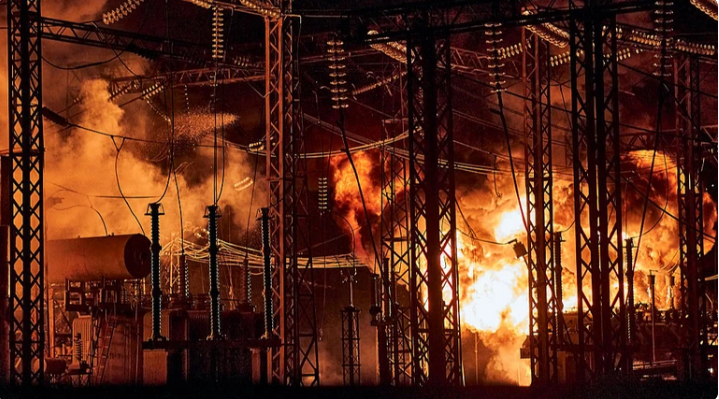
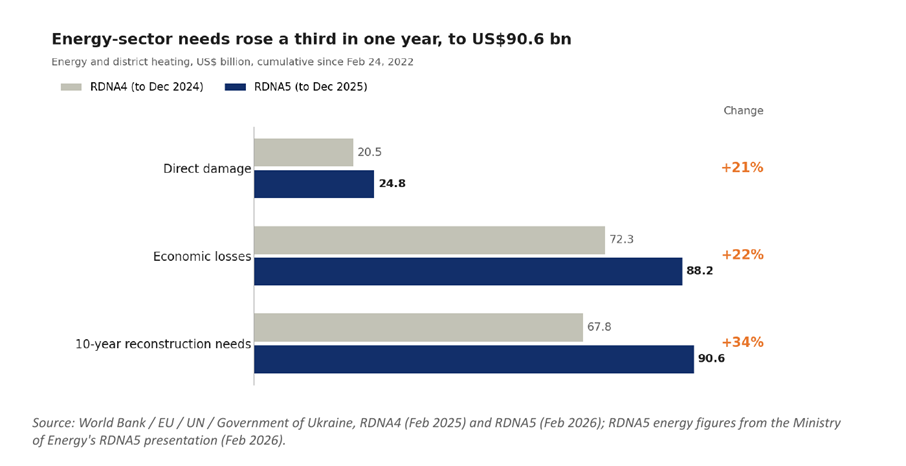
In October 2022, Russia began a large-scale campaign of aerial strikes on the power grid of Ukraine, aiming to plunge the population of the country into darkness right before the cold season sets in. This pattern of warfare became typical over the last four years of the full-scale war. Now Ukraine's energy system is entering its fifth wartime winter, already worn thin. According to the latest World Bank-led damage assessment (RDNA5, with data through December 31, 2025), the sector has suffered US$24.8 billion in direct damage, US$88.2 billion in economic losses, and needs US$90.6 billion over the next ten years to rebuild. These numbers tell only part of the story, because Russian strikes have not stopped since that cut-off date, and the winter of 2025/26 was, by most measures, the worst of the full-scale war so far. A new wave of attacks began on September 29–30, 2026, which Prime Minister Koretskyi called the largest combined strike on the energy system since the end of the last heating season. Then, on October 13–14, a strike with 39 ballistic missiles and more than 120 drones hit Kyiv and Kharkiv, leaving over 600,000 people without power — only days after a US-announced “energy ceasefire” that, on the ground, changed very little.
The physical picture behind these figures is stark. Before the full-scale invasion, Ukraine operated roughly 38 GW of dispatchable generating capacity, a nuclear-and-coal system that even exported electricity to Europe. By mid-2024, after two years of occupation and bombing, that number had fallen to about 12 GW — a loss of nearly two-thirds.
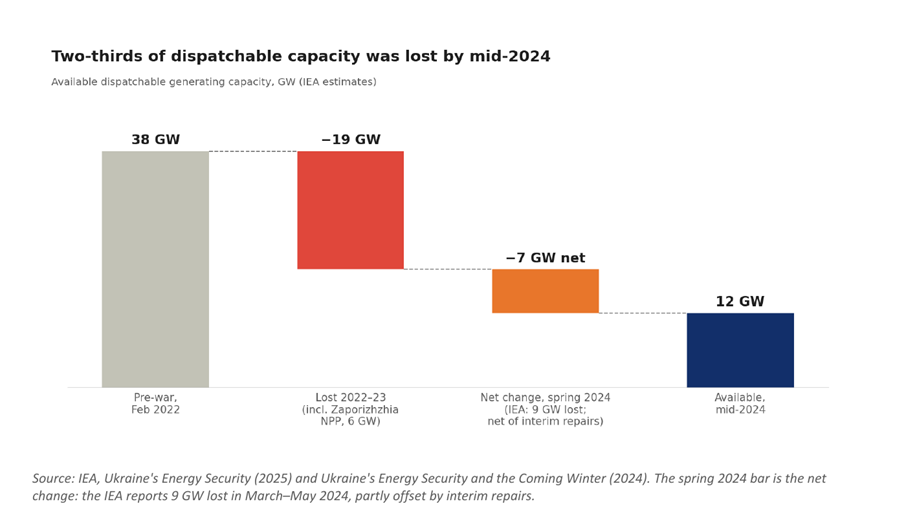
The 2025/26 winter campaign then damaged or destroyed roughly 9 GW more, which was over half of what remained available before that winter. By July 2026, average grid generation stood at about 10 GW, against 14 GW in July 2021. Nuclear power now carries 53–55% of all output, while the country depends on electricity imports for up to 20% of winter consumption and on a fast-growing fleet of small, distributed generation and storage units, which are far harder for Russian missiles and drones to find and hit.
A regional map of the damage, built from the Energy Charter Secretariat Task Force assessment that still serves as this report's baseline, shows how uneven the destruction already was by September 2022: 44% of thermal capacity and the 6 GW Zaporizhzhia nuclear plant, 43% of pre-war nuclear capacity, were under occupation.
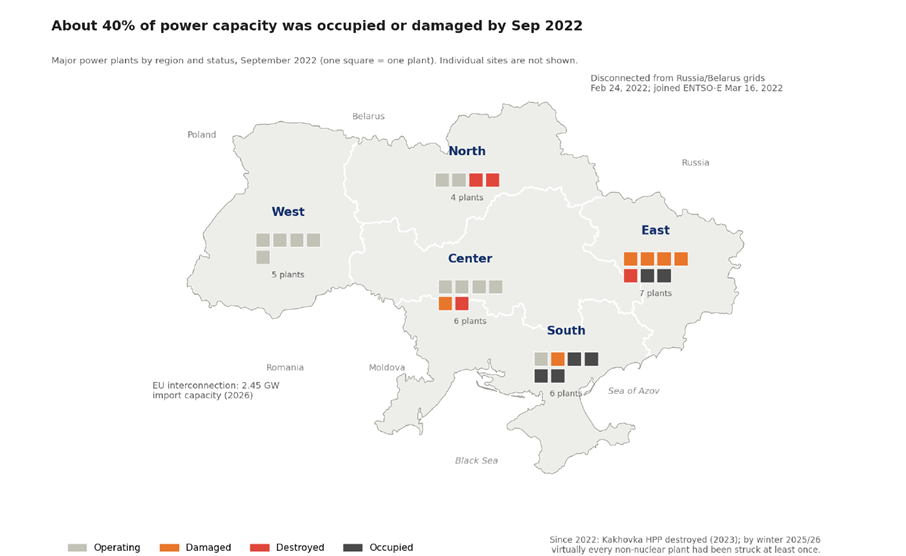
Since then, Russia has carried out more than 6,000 attacks on Ukraine's energy system, according to the Razumkov Centre, and the pattern of targeting has shifted over time: transmission lines in 2022, power plants in 2024, and gas, heat and generation together in 2025–26. Kyiv's Darnytsia combined heat and power plant was destroyed, according to the Centre for Eastern Studies (OSW), and was reportedly struck again on October 13, 2026. By the 2025/26 winter, virtually every non-nuclear power plant in the country had already been hit at least once.
The cost of rebuilding is climbing even faster than the physical damage. In 2025 alone, direct damage to the energy sector rose 21% and economic losses rose 22%, but ten-year reconstruction needs jumped 34%, from US$67.8 billion to US$90.6 billion — mostly because rebuilding to a modern, protected standard now costs far more than simply restoring what existed before the war.\
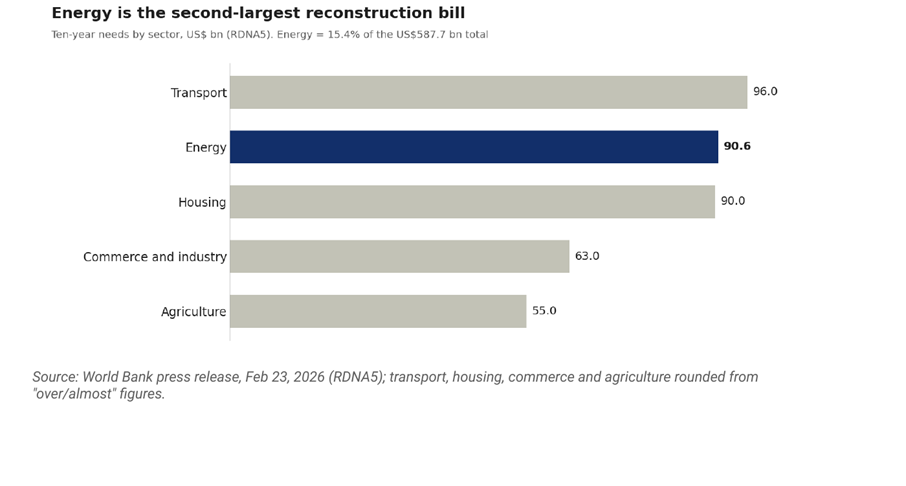
Energy is now the second-largest reconstruction bill in the country after transport, accounting for 15.4% of Ukraine's total US$587.7 billion in recovery needs. Financing has not kept pace with the need: Ukraine's 2026 priority recovery program requires US$15.25 billion and is only about 38% secured, while district heating, with a need of US$1.6 billion, is funded at under 1%. Meanwhile, the balancing-market debt owed to Ukrenergo, the national grid operator, has reached UAH 46.5billion — a slow-moving crisis that could, if left unaddressed, start limiting maintenance and fuel stocking before it limits anything else.
Stepping into the 2026/27 heating season, Ukraine is better stocked than a year ago, but it is not necessarily better protected. Gas storage reached its 14.6 bcm target a month early, in late August, and about 1.9 GW of new distributed generation has been added since mid-2024. But the larger repair and rebuild program — 4 GW of repairs to existing plants plus 1.5 GW of new decentralized capacity — is behind schedule, with most of the work still due between September and November. The report identifies the clearest near-term danger as a shortage of air-defense interceptors, above all the Patriot systems needed to protect repaired plants and substations from ballistic strikes, and the clearest structural danger as the sector's growing debt spiral. Its recommendation, in short, is not to rebuild Ukraine's energy system as it stood before the war, but to rebuild it smaller, more dispersed, and genuinely harder to destroy.