

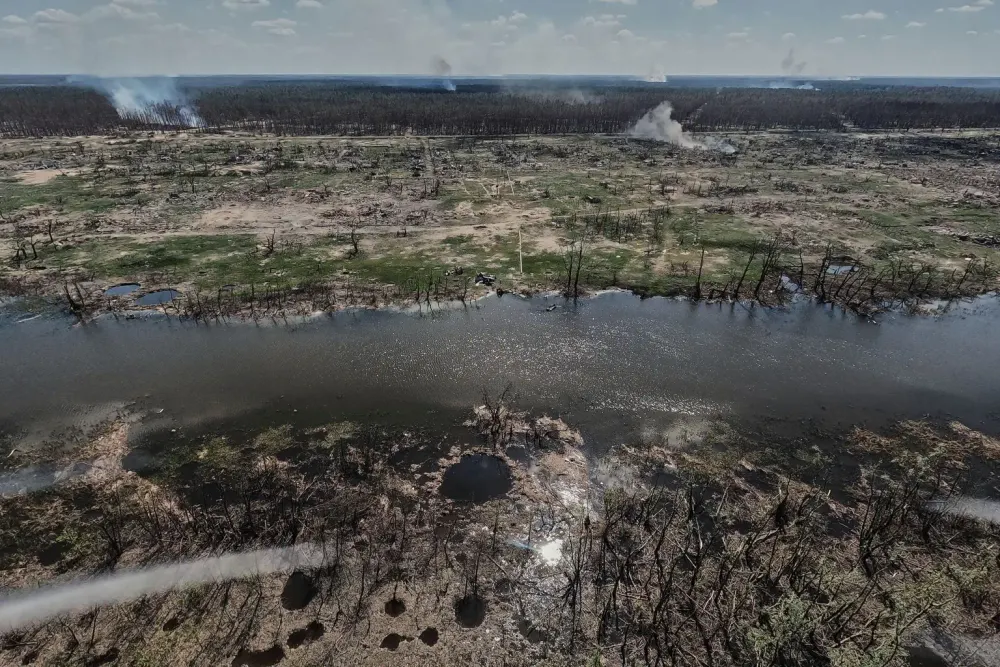
Russian forces took advantage of a five-day humanitarian ceasefire in Kherson Oblast, held from October 27 to November 1, to allow the evacuation of civilians from occupied Oleshky, to rotate troops, reinforce positions, and increase ammunition deliveries. “We were betting on (Russians) trying to bring in (a lot of military supplies). And our assumptions turned out to be correct,” said Yevhen Voronetskyi, head of the 34th Marine Brigade’s communications department. Ukrainian officials recorded the rotation of units, strengthening of positions, expansion of anti-drone defenses, and a clear rise in logistics activity, some of it carried out with vehicles marked with red crosses.
Ukrainian commanders reported multiple violations of the agreement that banned large-scale troop and equipment movements. Russian forces flew reconnaissance drones over the western bank of the Dnipro and remotely laid mines before the ceasefire began; one such device later killed a Ukrainian press officer in Kherson. “Civilians need to be very attentive… and take into account that Kherson is right on the contact line and that the situation there is indeed difficult,” said Pavlo Drohal, press officer for the 30th Marine Corps. Since the truce ended, drone and artillery attacks on the city and nearby communities have resumed at high intensity.
The Dnipro River’s wide channels, islands, and wetlands make any large-scale crossing extremely difficult. Russian forces attempted small boat landings before the ceasefire and have continued short raids afterward. Analyst Viktor Kevliuk of the Center for Defense Strategies noted that even if several hundred troops managed to land, “that would not yet mean that a full-fledged bridgehead has been established,” because a true bridgehead requires continuous resupply, fire support, and the ability to receive reinforcements and repel counterattacks.
Military officers and analysts doubt that a major offensive to retake Kherson is imminent. “The most important question now is whether the buildup of Russian forces on the left bank is a preparation for a sustained offensive operation, rather than simply an attempt to increase pressure on Kherson,” Kevliuk said. Most assessments point to the reinforcement as an effort to tighten the grip on the regional capital, disrupt civilian life, and improve defensive positions rather than launch a sustained river-crossing operation in the near term.