


Charges likely identified chief of Zelensky’s office as organizer of money laundering scheme
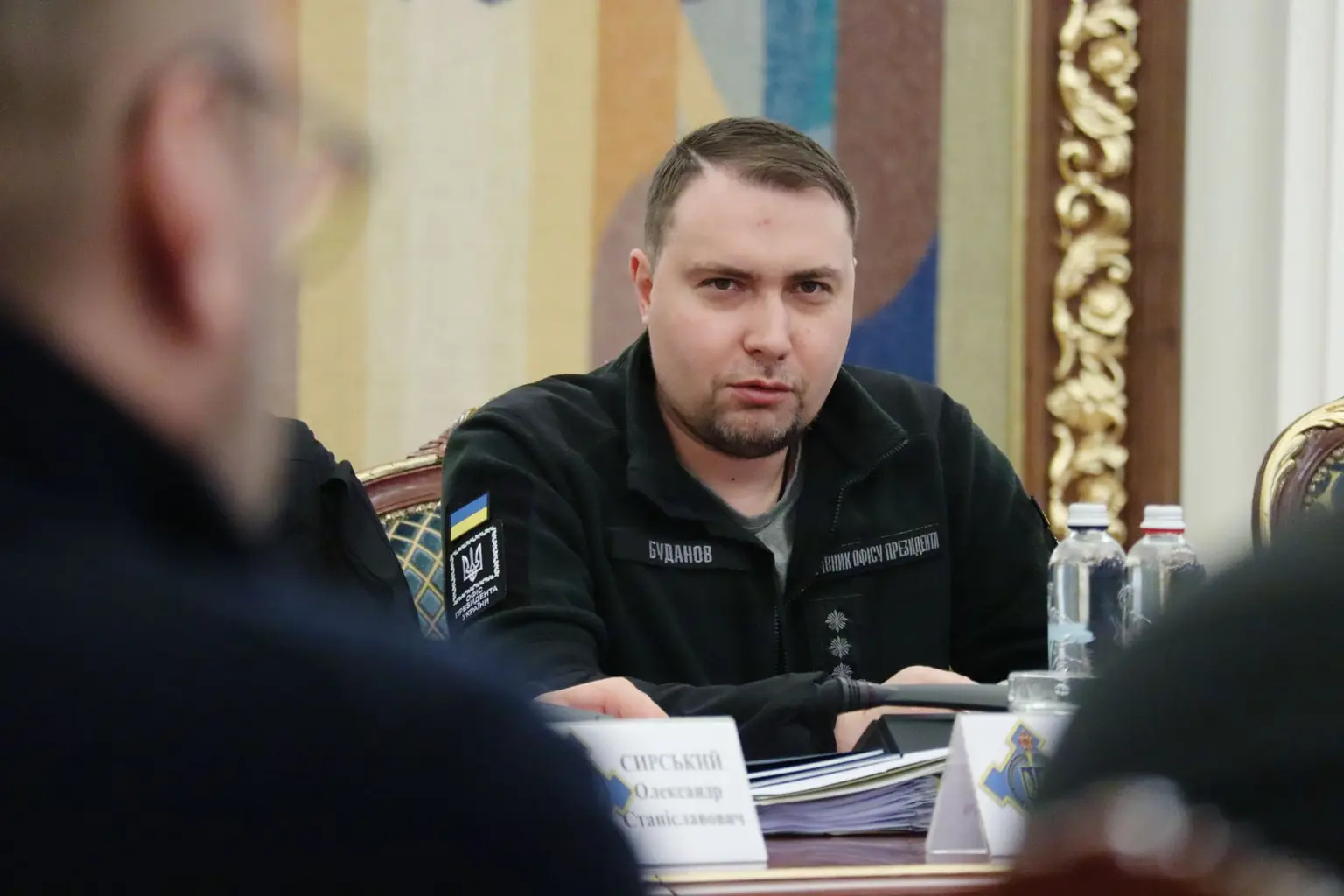
A person matching the description of Kyrylo Budanov, head of the President’s Office, allegedly asked his deputy to launder cash to pay bail for former Energy Minister Herman Halushchenko. According to leaked documents published by Bihus.info (journalist investigation), Zelensky’s associate Timur Mindich asked this person to help organize the payment of Halushchenko’s bail. Mindich also reportedly transferred informal control over Sense Bank to the same person.
The charges say that in June 2026, Iryna Mudra received a proposal from an official of the President’s Office to launder criminal cash. She was asked to run the money through accounts of controlled companies to make it look legal and then send it to the High Anti-Corruption Court as bail for Halushchenko. Being dependent on this official and wanting to stay in his good graces, Mudra agreed to the plan.
Later, Timur Mindich, who was wanted by authorities, asked this same official to take informal control over Sense Bank. The bank’s management reportedly agreed to follow instructions from this person and Mudra after their previous “overseer,” Mindich, could no longer fully manage it. The bail for Halushchenko was eventually paid through Sense Bank.
This scandal is part of a series of large corruption investigations during Zelensky’s presidency. The leaked documents and secret recordings mention “Kyrylo” and “Kyrylo Oleksiyovych” ( Budanov's patronymic name), which perfectly aligns with Budanov, as there is nobody with this name in that circle who has fallen under investigation by NABU. When asked about it, Budanov told journalists: “Let the court sort it out.”
Russia plans to build seven "super-prisons", including in occupied Kherson Oblast
Russian authorities plan to build seven large prison complexes by 2035 that would combine pretrial detention centers with correctional facilities of different security levels, including one in the Russian-occupied part of Ukraine’s Kherson Oblast, The Moscow Times reported September 16, citing a revised federal penal-system development program.
The facilities are expected to have a combined capacity of more than 20,000 inmates, including 5,380 places in pretrial detention centers and 15,120 in correctional colonies. Russia plans to build the complexes in the Kaluga, Astrakhan and Tyumen regions, Buryatia, Zabaykalsky Krai and occupied Kherson Oblast. The first facility is scheduled to open in Tatarstan by 2030.
Russia’s Justice Ministry estimates that operating the multi-regime facilities could reduce the cost of detaining prisoners and suspects by 25% to 30%. The complexes are also expected to use new organizational and engineering systems, including information technology, while providing improved working conditions for prison staff.
Federal Penitentiary Service chief Arkady Gostev said no new correctional colonies have been built in Russia since 1984. Justice Minister Konstantin Chuychenko previously said the planned facilities would incorporate “cutting-edge” solutions designed to improve their operation.
Kremlin begins preparations for possible attack on Baltic States
Russia is planning to reserve approximately 16,000 to 20,000 additional beds in civilian hospitals for military use in the coming months, according to recent media reports. The majority of these beds are concentrated in regions near the Baltic countries.
A significant portion of the new capacity is planned for Northwestern Russia — including St. Petersburg, Leningrad Oblast, Novgorod Oblast, and Karelia — areas close to the Baltic Sea. Additional beds are also being prepared in Smolensk and Moscow oblasts. Analysts note that a similar expansion of medical infrastructure took place in regions bordering Ukraine before the full-scale invasion in 2022.
The increase in hospital capacity near the Baltic region fits into a wider pattern of Russian preparations for potential confrontation with Europe. While it does not by itself confirm an imminent attack, the geographic focus and scale of the medical buildup are being viewed by observers as a concerning indicator of possible future military planning directed toward NATO’s eastern flank.
Russia is developing low-cost cruise missiles
Russia is working on cheap cruise missiles that can reach speeds of up to 750 kilometers per hour while flying at very low altitudes. According to Serhiy "Flash" Beskrestnov, an advisor to President Zelensky on defense technologies, these weapons could start being used in large numbers in about five to six months.
According to Flash, this is the next step after the jet-powered Shahed drones. Russia understands that Ukraine is developing fast interceptors to protect cities like Kyiv, so they're moving to a new class of small, low-cost cruise missiles. Among the systems he mentioned are "Banderol", "Dan-T", "Dan-M", and "Gerbera-5".

These missiles will be able to actively maneuver and fly much lower than current drones, which will make them significantly harder for Ukrainian air defense to intercept. Flash warns that Ukraine needs to start developing its own cheap solid-fuel interceptor missiles right now — because in six months, the current solutions being built for jet Shaheds may no longer be fast enough.