


Putin set a price on Trump's Ukraine energy truce
As Russia intensifies its strikes on Ukraine’s already battered energy grid, Vladimir Putin has quietly attached a steep price tag to any possible pause in the attacks. While Kremlin spokesman Dmitry Peskov publicly dismisses the idea of a limited energy ceasefire as pointless, Russian negotiators have been telling American envoys a different story behind closed doors: Moscow is prepared to discuss a halt to strikes on power plants — but only in exchange for sanctions relief.
The demand emerged during recent meetings between Trump’s special envoys Steve Witkoff and Jared Kushner and Russian representative Kirill Dmitriev. According to Ukrainian and U.S. officials familiar with the talks, Dmitriev made clear that any agreement on energy infrastructure would have to come with the lifting of certain Western restrictions. What exactly Moscow wants remains deliberately vague, though one European diplomat warned that the release of frozen Russian assets would almost certainly be used to fuel further escalation rather than peace.
For Kyiv, the proposal looks less like diplomacy and more like classic Russian leverage-building. While Ukrainian cities endure daily blackouts and Russian missiles continue to hit power facilities, the Kremlin is attempting to extract economic concessions simply for agreeing to stop doing what it should never have started. Ukrainian officials insist that any pause must be strictly reciprocal — both sides stop attacking energy targets — and reject the idea of rewarding Russia with sanctions relief for temporary restraint.
Washington, eager to show some form of progress before the midterm elections, continues to push the narrower energy-and-Black Sea package as a possible first step. Yet the emerging Russian conditions raise a familiar and uncomfortable question: is Moscow genuinely interested in reducing civilian suffering, or is it simply using the negotiations to buy time, weaken sanctions, and keep striking Ukraine’s critical infrastructure while the talks drag on?
Russia has removed 25 Ukrainian civilians, including children, from occupied Kharkiv Oblast by force
Russian forces have forcibly taken 25 Ukrainian civilians, including children, from occupied territory in Kharkiv Oblast to an unknown location, Ukraine’s Human Rights Ombudsman Dmytro Lubinets reported on October 9.
The group, which included children, young people, and elderly residents, was removed from an area where active fighting continues. Their current whereabouts and the conditions under which they are being held remain unknown. Lubinets rejected Russia’s claim that the operation was an “evacuation,” stating that people were taken against their will under intimidation and left with no real choice.
Russian occupation authorities published footage of the operation on Telegram, which Lubinets said showed clear signs of pressure and coercion. He also warned that a Telegram bot set up by the occupation administration to collect personal data under the pretext of evacuation could put civilians and their relatives at further risk.
Forcible transfers of civilians from occupied territory are prohibited under the Fourth Geneva Convention. Lubinets has formally appealed to Russia’s human rights commissioner, the International Committee of the Red Cross, the United Nations, and other international organizations, demanding information about the 25 people and their safe return to Ukraine.
Ukrainian investigative journalists detained in Vienna like terrorists
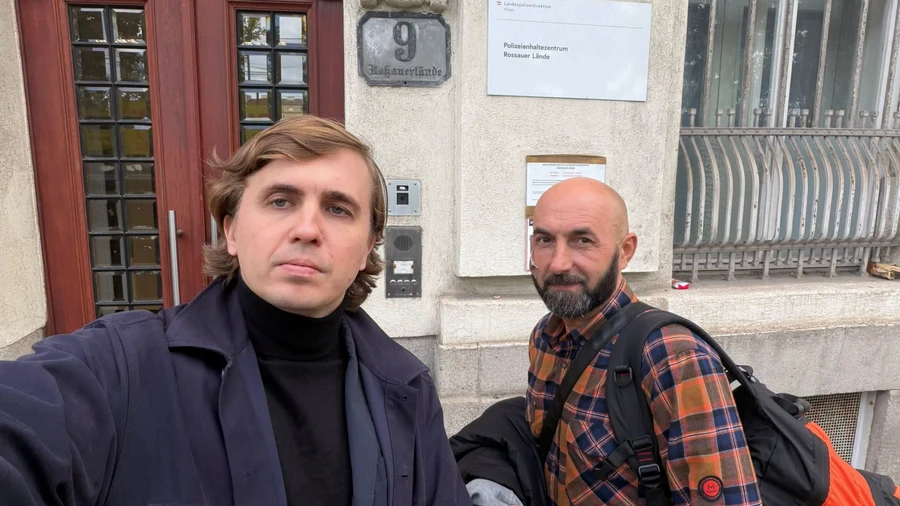
On October 8, while carrying out a routine editorial assignment in Vienna in a search for fugitive former Prosecutor General Ruslan Kravchenko, who is involved in an organized crime gang covering up scam call centers, Ukrainska Pravda’s head of investigations Mykhailo Tkach and cameraman Yaroslav Bondarenko were suddenly surrounded by seven masked, heavily armed men. The officers smashed the car windows, dragged the journalists onto the road, forced them face down, and taped their hands behind their backs. One of the masked men knelt on Tkach’s neck while the journalist repeatedly shouted that he was a member of the press. For the first half hour, Tkach believed he had been abducted.
Only later did it become clear that the operation had been conducted by Austrian police. Tkach was taken to a station, placed in solitary confinement, ordered to strip, weighed, measured, and eventually presented with formal allegations. According to the journalist, the charges listed against him and Bondarenko were espionage on behalf of Ukrainian military intelligence, participation in a criminal organisation, and causing harm to Austria. No concrete evidence was presented during the interrogation.
Ukrainska Pravda’s editorial team immediately declared the detention unlawful and demanded the journalists’ release. Editor-in-Chief Sevgil Musaieva appealed to the Ukrainian and Austrian diplomatic services, as well as international press freedom organisations. Ukrainian diplomats managed to gain access to Tkach, and by the morning of October 9 he was released. Cameraman Yaroslav Bondarenko, however, remained in custody and had sustained injuries during the violent arrest.
The episode has raised serious questions about how two Ukrainian journalists conducting open, public-interest reporting in the centre of a European capital could be treated as terrorists. Austrian authorities have so far offered only limited explanations, while the Ukrainian side continues to insist on full transparency and the immediate release of the still-detained cameraman.