


Zelensky warns of possible Russian Oreshnik missile attack on Ukraine
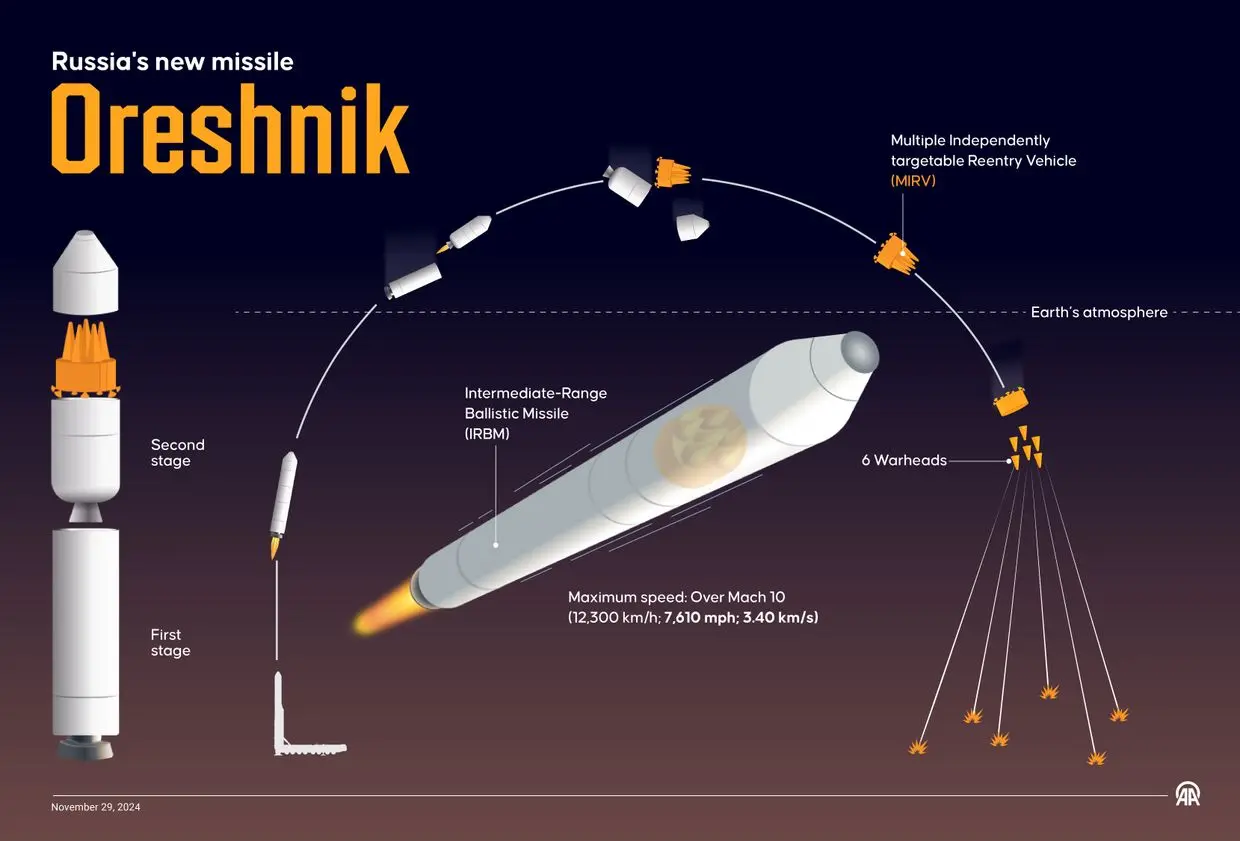
President Volodymyr Zelensky warned on May 23 that Russia may be preparing to use its Oreshnik intermediate-range ballistic missile in a large-scale strike against Kyiv and other parts of Ukraine.
According to Zelensky, Ukrainian intelligence services, together with information received from American and European partners, have identified signs that Russia could be preparing a major combined attack involving multiple types of weapons.
“Our intelligence services reported receiving data, including from American and European partners, about Russia preparing a strike with the Oreshnik missile. We are verifying this information,” Zelensky said.
The Ukrainian president added that the potential assault could involve a mixture of missile and drone strikes, with the Oreshnik system possibly being used as part of the operation.
The Oreshnik is a medium-range ballistic missile believed to be a modified version of the Russian Rubezh missile system, which itself is based on Soviet-era ballistic missile technology. Russia first used the missile against Ukraine in November 2024 during an attack on Dnipro. The weapon was reportedly used again in a strike on Lviv Oblast in January 2025.
Zelensky urged Ukrainians to take air raid alerts seriously and use shelters when warnings are issued.
“It is important to act responsibly on air-raid alerts, starting this evening. Russian madness truly knows no bounds, so please protect your lives,” he said.
The president also called on Ukraine’s Western allies to increase pressure on Moscow, warning that failing to stop Russia’s aggression could encourage similar actions by other authoritarian governments in the future.
Zelensky stressed that Ukraine is continuing efforts to strengthen its air defence systems and said the country would respond to Russian attacks. He added that the war must end through peace rather than continued missile strikes and escalation.
US senators are questioning Hegseth regarding the delayed $400 million aid package for Ukraine
A bipartisan group of U.S. senators has urged Pete Hegseth to release a previously approved US$400 million military aid package for Ukraine that has reportedly been delayed at the Pentagon for several months.
The May 23 letter was led by Republican Senator Chuck Grassley and Democratic Senator Dick Durbin. According to reports, lawmakers have grown increasingly frustrated over delays involving a broader US$600 million regional security package that includes US$400 million for Ukraine and US$200 million for the Baltic states.
Congress approved the Ukraine portion of the funding in December 2025 under the Ukraine Security Assistance Initiative as part of a larger US$900 billion defence spending bill. However, despite approval by lawmakers, the package has reportedly remained stalled within the Pentagon.
Hegseth previously told the House Armed Services Committee on April 29 that the funding had finally been unlocked after bureaucratic issues were resolved. Senators said the Pentagon also promised to provide a spending plan to Congress by May 15, but lawmakers claim they still have not received details explaining how the money will be distributed.
In the letter, senators warned that further delays could weaken deterrence against Russia, especially amid reports that the Pentagon may reduce U.S. troop deployments in Europe.
“Ukraine has persistently and bravely repelled a four-year Russian onslaught, but its military needs and deserves continued American support,” the lawmakers wrote.
The letter was signed by three Republican and three Democratic senators, reflecting bipartisan support for continued military assistance to Ukraine despite broader political debates in Washington.
Since returning to office in January 2025, Donald Trump has not approved new military aid packages for Ukraine through the Presidential Drawdown Authority, the emergency mechanism frequently used by former President Joe Biden.
Instead, the Trump administration has focused on arms transfers through NATO partners using the Prioritized Ukraine Requirements List programme.
On May 21, the United States Department of State approved a separate US$108.1 million sale of equipment to Ukraine to support the HAWK air defence missile system.
The US Embassy warns of a possible large-scale Russian strike on Ukraine within 24 hours
The Embassy of the United States in Kyiv has warned about the possibility of a large-scale Russian airstrike against Ukraine within the next 24 hours.
In a security alert published on its website, the embassy said it had received information about a potentially significant air attack that could occur at any time during the coming day.
“The US embassy in Kyiv has received information concerning a potentially significant air attack that may occur at any time over the next 24 hours,” the statement said.
The embassy urged American citizens in Ukraine to be prepared to immediately seek shelter if air raid sirens are activated.
The warning comes amid growing concerns about possible new Russian missile attacks. Earlier on May 23, Volodymyr Zelensky said Ukrainian intelligence and Western partners had detected signs that Russia could be preparing a combined strike involving various weapons, including the Oreshnik intermediate-range ballistic missile.
The embassy noted that it had issued a similar security warning on 8 January 2025. During the night of 8-9 January, Russian forces launched an Oreshnik missile strike against Lviv Oblast.
Russia conducted over 24 hours of strikes on Ukrainian oil and gas facilities in Kharkiv and Poltava oblasts
Ukrainian Oil and Gas company Naftogaz Group informed that Russian forces have been conducting a large-scale attack on the company’s oil and gas infrastructure in Kharkiv Oblast and Poltava Oblast for more than 24 hours.
According to the company, several critical infrastructure facilities were struck simultaneously. The attacks caused major damage to equipment and triggered large fires at the affected sites.
Serhii Koretskyi said company personnel had been evacuated from the facilities for safety reasons.
“It is currently impossible to assess the aftermath of the attacks due to the risk of further strikes,” Koretskyi said, adding that more information would be released later.
Naftogaz reported that emergency and specialised services are continuing to work at the affected locations, though the overall situation remains difficult. The attacks come amid continuing Russian strikes against Ukraine’s energy infrastructure, which Moscow has repeatedly targeted throughout the full-scale war.
The Hungarian government will ban imports of a large share of Ukrainian agricultural goods
Hungarian Prime Minister Péter Magyar has announced that Hungary will ban imports of a wide range of agricultural products from Ukraine.
In a statement published on Facebook on May 22, Magyar said the Hungarian government was withdrawing its intention to leave the International Criminal Court and would also introduce restrictions on Ukrainian agricultural imports.
According to a government decree published in the Hungarian Gazette and cited by Hungarian media outlet Telex, the ban applies to numerous Ukrainian agricultural products, including beef, pork, lamb, goat meat, poultry, eggs, honey, vegetables, wheat, rye, barley, maize, buckwheat, flour, sunflower seeds, edible oil, and wine.
The restrictions apply to products originating from Ukraine but do not cover goods transiting through Hungarian territory. However, transit shipments will face strict control measures. Authorities warned that violations could result in fines equal to up to 100% of the value of the transported goods, excluding VAT.
Hungarian officials said the measure is aimed at protecting domestic farmers and food markets.
The minister of agriculture and food, Szabolcs Bóna stated that Hungary would not allow Ukrainian or other imported agricultural products to threaten the livelihoods of Hungarian farmers or the country’s food supply.
According to Bóna, safeguarding Hungarian agricultural products and farmland is considered a matter of national interest, and the government intends to strengthen legal protections for the domestic market.
The move continues longstanding tensions between several Central European countries and Ukraine over agricultural imports, with governments in the region arguing that cheaper Ukrainian products place pressure on local producers.