
Daily Flyer - March 25, 2026
A voice of Ukraine to the West


a
Ukraine strengthens its energy security for the upcoming winter by forming closer ties with U.S. businesses
Ukraine is stepping up efforts to rebuild its heavily damaged energy sector ahead of next winter, seeking support from U.S. companies and investors. During a visit to the United States, Energy Minister Denys Shmyhal said Ukraine needs an estimated $91 billion over the next decade to restore and modernize its energy infrastructure, citing World Bank data. Russia’s sustained strikes over the past fall and winter destroyed or damaged around nine gigawatts of generation capacity, leaving millions without heat and electricity.
To accelerate recovery, Ukraine signed agreements with U.S.-based partners, including Aspect Holdings to support hydrocarbon development and Solar Turbines to help repair critical equipment domestically and train Ukrainian engineers. State energy giant Naftogaz also reached multiple agreements, including closer cooperation with the American Petroleum Institute to align with U.S. industry standards. These steps are aimed at reducing repair times and strengthening long-term resilience.
Officials say urgent preparations are already underway, as rebuilding timelines for key equipment can take up to a year, and domestic production remains limited. The government has allocated additional funding to protect infrastructure and expand decentralized energy systems. Prime Minister Yuliia Svyrydenko said priorities include strengthening defenses around energy facilities, increasing distributed generation, and securing backup power sources to ensure a stable heating and electricity supply during the next winter season.
Russian forces have likely initiated the Spring-Summer 2026 offensive against Ukraine's primary defensive position, the Fortress Belt, in Donetsk Oblast
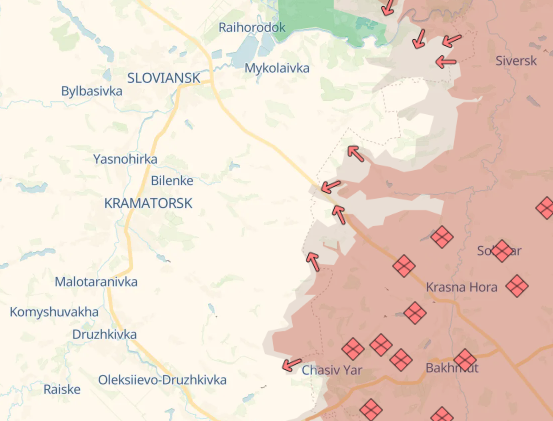
Russian forces have intensified offensive operations in the Lyman direction as part of a broader effort to advance toward Slovyansk, a key stronghold in eastern Ukraine. According to Ukrainian military reports, elements of Russia’s 1st Guards Tank Army and 20th Combined Arms Army launched a large, battalion-sized assault on March 19 involving more than 500 troops, armored vehicles, and a significant number of motorcycles and all-terrain vehicles. The scale of the attack marks a notable increase compared to recent Russian assaults in the area.
Ukrainian officials say Russia is adapting its tactics by dispersing forces across multiple attack directions rather than advancing in concentrated columns. This approach is likely intended to overwhelm Ukrainian drone-based defenses and stretch frontline positions. At the same time, Russian forces are increasing the use of aerial weapons, including guided glide bombs and loitering munitions, in an effort to weaken Ukrainian logistics and defensive capabilities ahead of further ground advances.
Military analysts say control of Lyman is strategically important, as it could serve as a staging point for future offensives toward both Slovyansk and Kramatorsk. The intensified pressure in the area suggests Russia is attempting to create conditions for a broader push deeper into the Donbas region in the coming months.
Ukraine calls for Russia to be expelled from UNESCO
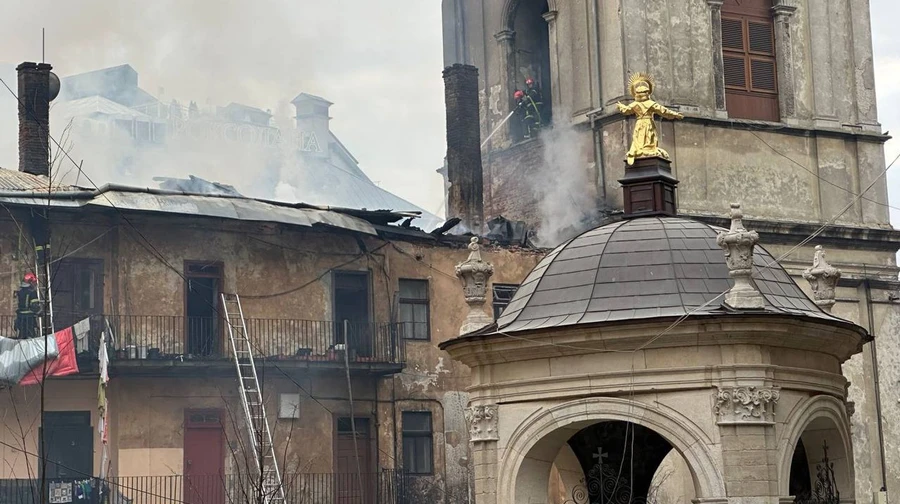
The Ukrainian Institute of National Memory is urging UNESCO and international partners to expel Russia from the organization, citing widespread destruction of cultural heritage during the war in Ukraine. The institute has launched a public petition, calling on Ukrainians to add their names before it is formally submitted, as part of a broader appeal for coordinated international action.
In its statement, the institute accused Russia of systematically violating international law, including attacks on civilians, the abduction of children, and the destruction of more than 1,600 cultural heritage sites since the start of the full-scale invasion. It highlighted a recent strike that damaged historic areas under UNESCO protection, including the Bernardine Monastery, a 17th-century landmark.
The initiative reflects growing efforts to hold Russia accountable in international cultural institutions. Similar calls have been made previously, including a petition by a French advocacy group to remove Russia from the International Council of Museums, citing alleged involvement of Russian museum officials in the looting of Ukrainian cultural artifacts from occupied territories.