


Another drone strike on St. Petersburg Oblast ahead of Putin's economic forum finale confirmed
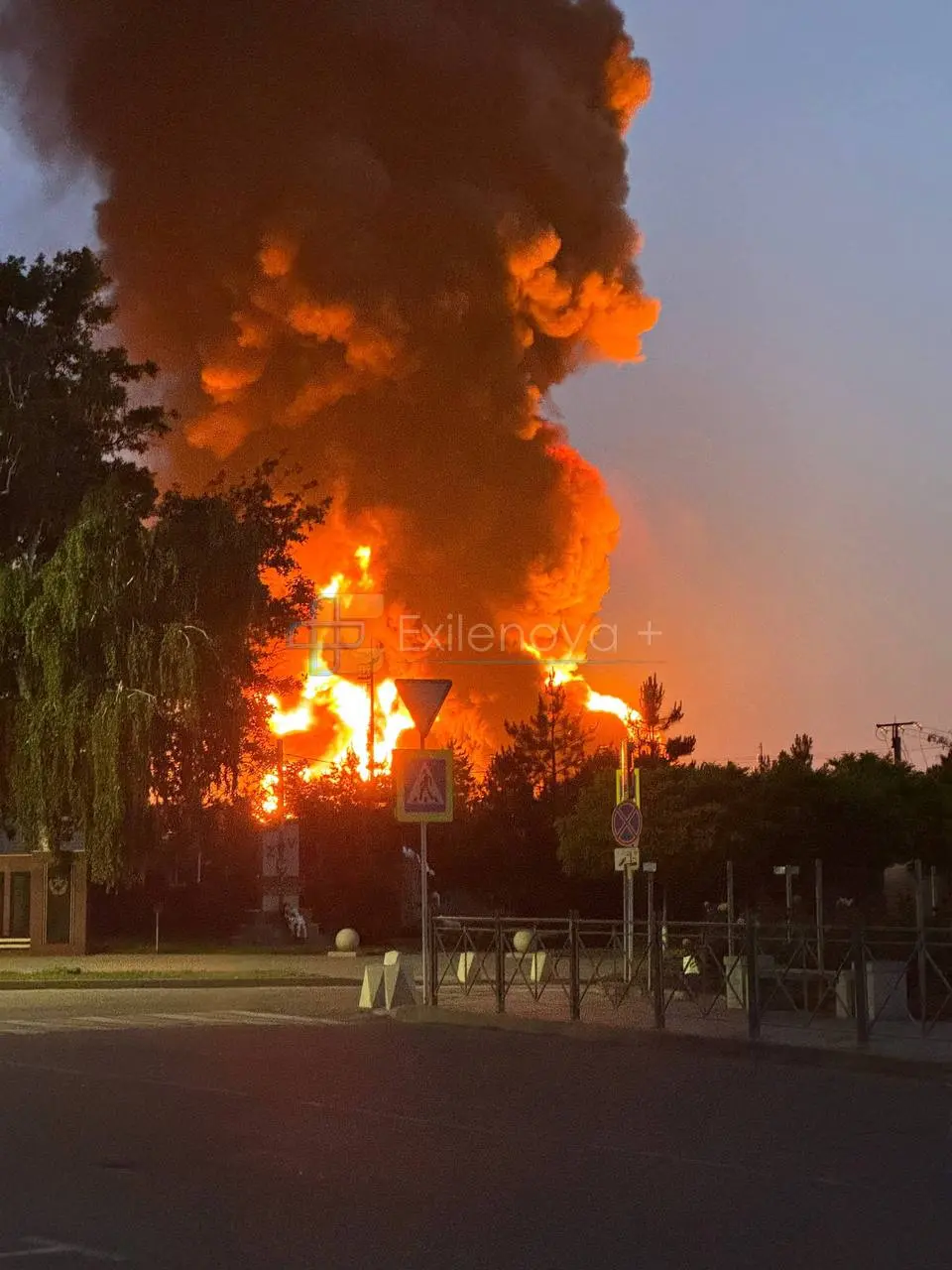
Russia launched one of its largest long-range drone attacks overnight on June 6, striking military and logistical targets across several Russian regions. According to President Volodymyr Zelensky, Ukrainian drones reached up to 1,000 kilometers inside Russia, hitting naval facilities near St. Petersburg, including ammunition storage sites in Leningrad Oblast and military infrastructure in Kronstadt. An oil depot in Krasnodar Krai was also reportedly set on fire.
Ukraine's Security Service (SBU) said the strikes targeted facilities supporting Russia's Baltic Fleet and military operations, including a major naval arsenal where secondary explosions were reported. Russian authorities confirmed large-scale drone activity, claiming that air defenses shot down 376 drones overnight, including more than 140 over Leningrad Oblast.
The attacks also reportedly affected fuel and port infrastructure in Krasnodar Krai and occupied Mariupol. Local authorities in Russia evacuated residents near some of the targeted sites, while temporary restrictions were introduced in Kronstadt.
Zelensky said the operation was aimed at military infrastructure supporting Russia's war effort and reiterated that Ukraine would continue responding to Russian aggression. The strikes came a day after Vladimir Putin rejected Zelensky's proposal to resume peace negotiations.
Russian President Vladimir Putin rejected Ukrainian President Volodymyr Zelensky’s offer to negotiate an end to the war
Russian President Vladimir Putin has clearly showcased that the Kremlin remains committed to achieving its war objectives in Ukraine. Speaking at the St. Petersburg International Economic Forum (SPIEF) on June 4–5, Putin claimed that Russian forces continue to advance across the entire front and that a Russian military victory is inevitable. He also asserted that Russian troops control all of Luhansk Oblast, around 85% of Donetsk Oblast, and roughly 80% of Zaporizhzhia Oblast, while claiming Russian forces had captured about 2,440 square kilometers of territory during an unspecified period.
Putin further argued that Russia has reached drone parity with Ukraine and even holds an advantage in certain sectors. These statements reflect the Kremlin’s long-standing belief that Russia can eventually win through a prolonged war of attrition, relying on steady battlefield advances and superior resources. However, available evidence suggests that Russian battlefield performance has slowed in recent months, while the costs of sustaining such a strategy continue to rise.
Russia is facing growing economic pressures, declining recruitment rates, and increasing public dissatisfaction as the war drags on. At the same time, Ukraine has intensified its long-range strike campaign against military and industrial targets inside Russia and has challenged Russian forces in several frontline sectors. Despite these mounting difficulties, Putin’s remarks at SPIEF indicate that he remains committed to pursuing Russia’s military objectives and shows no sign of abandoning his strategy of continuing the war.
Last night, in his evening address, President Zelensky revealed that Putin's response had disappointed many people around the world and showed that the Kremlin remains committed to continuing the war rather than seeking peace.
"Sadly, the Russian side is choosing war again," Zelensky said. "He does not want to end the war. He does not want to change anything."
The Ukrainian president argued that continued international pressure on Moscow is necessary, calling for stronger sanctions and measures to reduce Russia's ability to finance its war effort.
Zelensky also revealed that he had held discussions with Ukraine's diplomatic team and that preparations are underway for a series of meetings with European and U.S. partners aimed at strengthening support for Ukraine and increasing pressure on Russia.
Putin and his circle again weaponize the Alaska Summit to pretend they want peace
Russian officials, including President Vladimir Putin, are again using the lack of publicly available details from the August 2025 Alaska Summit to portray Russia as open to negotiations while continuing to reject meaningful compromises. Responding to President Volodymyr Zelensky’s June 4 appeal for a ceasefire and a direct leaders’ meeting, Putin said he had only briefly reviewed the proposal and saw no reason for such a meeting. At the same time, he claimed Russia remains willing to reach a settlement with Ukraine, provided any agreement is based on understandings that he says were reached with U.S. President Donald Trump during the Alaska Summit.
Putin asserted that Russia is prepared to accept the compromises discussed between Russian and U.S. officials at the summit. Russian Foreign Minister Sergey Lavrov and Deputy Foreign Minister Mikhail Galuzin echoed those claims on June 4 and 5, arguing that Moscow had already agreed to American proposals for ending the war. However, neither Washington nor Moscow released any official statement or signed document outlining agreements reached during the summit. The absence of public documentation has allowed the Kremlin to present its own interpretation of the talks while avoiding scrutiny of its continued refusal to abandon maximalist demands.
At the St. Petersburg International Economic Forum on June 5, Putin reiterated that Russia’s military operations would continue until all of its objectives are achieved, underscoring that Moscow’s core war goals remain unchanged. He also issued indirect nuclear threats, stating that Russia has only used its nuclear-capable Oreshnik intermediate-range ballistic missile for testing purposes and suggesting that it has not yet been employed as intended. Such rhetoric appears aimed at increasing pressure on Ukraine and its Western partners at a time when Russia faces growing military and economic challenges, seeking to strengthen Moscow’s negotiating position through intimidation rather than compromise.