


Russian attack damaged over 40 homes in Kharkiv, 6 people injured
Russian forces launched glide bomb strikes on Kharkiv overnight on 19 June, damaging more than 40 homes and injuring at least six people, local authorities reported.
The attack targeted the city's Kholodnohirskyi district in the early hours of the morning. Emergency services responded to the scene as officials assessed the extent of the damage.
Kharkiv, located near the front line, remains a frequent target of Russian attacks. The latest strike follows a series of recent assaults on the city, including a double-tap attack on 15 June that killed four emergency responders and injured six others, as well as a drone strike on the Kharkiv Art Museum that wounded four people, including a one-month-old infant.
The attack came a day after Ukraine carried out its largest drone strike on Moscow since the start of Russia's full-scale invasion.
Zelensky met Hungarian PM Magyar at the EU summit
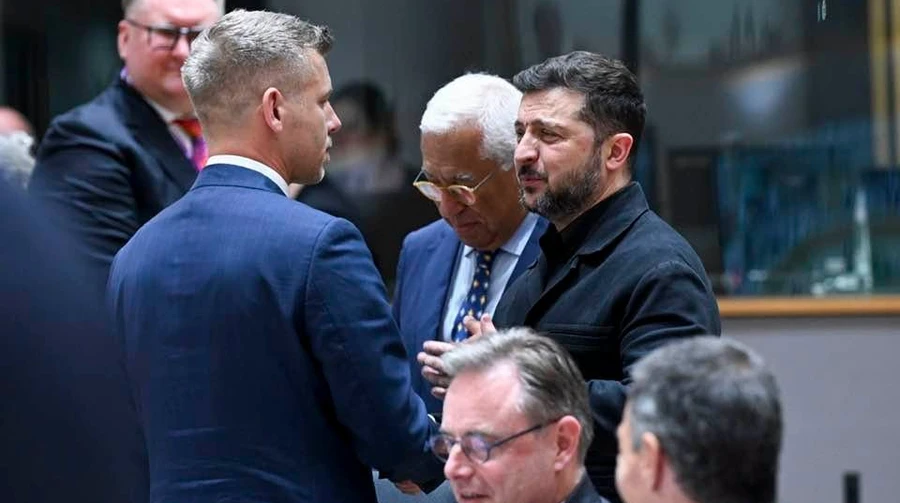
Ukrainian President Volodymyr Zelenskyy and Hungarian Prime Minister Péter Magyar held a brief conversation on the sidelines of the EU summit in Brussels.
While Magyar did not mention the meeting in his public remarks, a photo shared from the summit showed the two leaders speaking in the conference hall.
Commenting on the first day of the summit, Magyar said he called for greater honesty within the European Union and urged leaders to move beyond what he described as political correctness and double standards. He stressed that his priority is to represent the interests of the Hungarian people rather than seek popularity among European leaders in Brussels.
Ukrainian strikes against heavily defended Russian areas, such as Moscow City, continue to expose Russia’s weaknesses and its inability to protect its domestic populace
The Institute for the Study of War (ISW) says Ukraine's increasingly frequent and long-range drone strikes on major Russian cities such as Moscow and St. Petersburg are exposing growing weaknesses in Russia's air defence network.
According to ISW, even when Russian forces claim to intercept around 90% of incoming drones, the number that penetrate air defences is still causing significant damage to military, industrial and energy infrastructure. The report suggests Ukraine's improving drone capabilities are increasing the effectiveness of these attacks.
At the same time, reports indicate Russia may be facing shortages of S-300 air defence missiles. CBS News, citing Ukrainian officials familiar with Russian intelligence assessments, reported that sanctions have limited Russia's access to key components needed to produce the missiles.
Officials also said Russia has increasingly been forced to use advanced air defence interceptors against Ukrainian drones, while some S-300 missiles have been repurposed for strikes on ground targets in Ukraine. This could place additional strain on Russia's air defence resources as Ukraine continues expanding its long-range drone campaign.
Australia announceв $70 million in arms funding for Ukraine through the PURL initiative
Australia has announced a contribution of 100 million Australian dollars (about $70 million) to the Prioritized Ukraine Requirements List (PURL) initiative over the next year, helping fund the purchase of U.S.-made weapons for Ukraine.
The funding will be provided in two installments of 50 million AUD each. Australian Defence Minister David Marles said supporting Ukraine remains important for international security and stability.
The PURL program, launched by the United States and NATO in 2025, allows partner countries to finance the purchase of high-priority military equipment for Ukraine, including critical air defence systems and Patriot PAC-3 interceptor missiles.
Australia and New Zealand are among the non-NATO countries participating in the initiative, which now includes 25 nations. The announcement follows additional commitments to the program from Germany, Sweden and the Netherlands, while Belgium pledged seven more F-16 fighter jets for Ukraine.
As U.S. military aid has declined under President Donald Trump, Ukraine has increasingly relied on support from European partners and international funding mechanisms such as PURL to strengthen its defence capabilities.
Kremlin prepares ground to exploit the bus attack, claims the next wave of strikes on Ukraine
Ukraine's Security Service (SBU) says it has obtained internal Russian documents that contradict Moscow's claims that Ukrainian forces struck a passenger bus carrying a Belarusian children's football team in Russia's Bryansk Oblast on 17 June.
According to the SBU, internal reports from Bryansk Oblast's "Safe Region" monitoring system found no evidence of Ukrainian drones or other aerial objects in the area at the time of the incident. The documents reportedly challenge statements made by Russian and Belarusian officials, who accused Ukraine of carrying out the attack.
Belarusian leader Alexander Lukashenko later claimed the incident was an attempt by Ukraine to provoke Belarus and draw it into the war.
The SBU argues that the documents undermine those allegations and suggests the accusations were used as part of a broader Russian information campaign aimed at portraying large-scale Russian strikes on Ukraine as retaliation for alleged Ukrainian attacks on civilians.
On June 17, 2026, a passenger bus carrying a Belarusian children's football team was reportedly struck by a drone in Russia's Bryansk region, near the Ukrainian border. Russian officials claimed the attack killed one woman and injured several others, including children, and immediately blamed Ukraine for a deliberate "terrorist act." Kyiv has strongly denied any involvement, calling the accusation a fabricated pretext. The incident has quickly become a focal point for Russian propaganda, with the Kremlin already using it to justify potential large-scale retaliatory strikes against Ukraine.