


Ukraine holds trilateral talks with the USA and Russia; the Kremlin`s main condition is Donbas capitulation
Today, Ukraine began a two-day trilateral meeting with Russia and the United States in the United Arab Emirates, the UAE’s Foreign Ministry said, as Washington intensifies diplomatic efforts to push toward a settlement with Russia’s full-scale invasion entering its fourth year.
The talks come after a busy day of diplomacy yesterday, when President Volodymyr Zelensky met U.S. President Donald Trump at the World Economic Forum in Davos, while U.S. envoys held separate late-night discussions with Russian leader Vladimir Putin in Moscow.
The trilateral discussions in Abu Dhabi are expected to focus on two key issues: the future of the partially occupied Donbas region and a possible halt to attacks on energy infrastructure, proposals that Ukrainian and U.S. negotiators plan to present to the Russian side.
“The issue of Donbas is key,” Zelensky told reporters hours before the talks began. “It will be discussed, and the approaches of all three sides will be addressed today and tomorrow in Abu Dhabi.”
The negotiations opened under clear pressure from the Kremlin.
During meetings in Moscow on January 22, Russian leader Vladimir Putin told a U.S. delegation that without resolving the territorial issue, there was “no point in hoping” for a settlement of the war, according to Kremlin aide Yuri Ushakov.
Putin said any agreement must address the issue “according to the formula agreed upon in Anchorage,” referring to the Putin–Trump meeting held in August 2025.
Ahead of that Alaska summit, the Kremlin had demanded that Kyiv withdraw its forces from parts of Donetsk and Luhansk oblasts that are not fully occupied by Russia.
Ukraine’s delegation to the trilateral talks includes senior officials, among them National Security and Defense Council Secretary Rustem Umerov and Presidential Office head Kyrylo Budanov, according to officials familiar with the discussions.
Russia is represented by high-ranking Defense Ministry officials led by Admiral Igor Kostyukov, the head of Russian military intelligence. Top Kremlin envoy Kirill Dmitriev is also taking part, alongside U.S. Special Envoy Steve Witkoff.
Russian officials said the talks are split into separate tracks, with Dmitriev and Witkoff expected to focus primarily on “economic affairs,” while a dedicated working group addresses security issues. The economic agenda includes discussions on the possible use of Russian assets frozen in the United States to fund Ukraine’s postwar reconstruction, as well as to cover a proposed $1 billion membership fee for Trump’s Board of Peace.
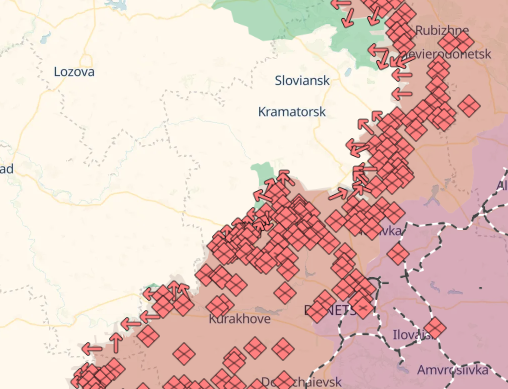
Territory remains the most contentious issue in the talks, with Russia linking any future ceasefire to Ukrainian withdrawal from Donbas — a demand Kyiv has described as capitulation after more than a decade of fighting in the region.
Luhansk Oblast is almost entirely under Russian control, while Ukrainian forces still hold roughly 6,600 square kilometers of Donetsk Oblast, including the key cities of Sloviansk and Kramatorsk. Ukraine has ruled out withdrawal, though officials have said alternative arrangements, such as a demilitarized zone, could be considered. The U.S. side has also floated the idea of a free economic zone in parts of the region.
President Volodymyr Zelensky has stressed that any territorial decision must be made by Ukrainians themselves, through elections or a referendum. A December poll showed about 75% of Ukrainians would reject a peace deal that includes withdrawal from Donbas without security guarantees. Despite this, the Kremlin has not shifted its stance, with spokesperson Dmitry Peskov reiterating that Ukraine’s withdrawal from Donbas remains a key Russian condition for ending the war.
Energy security forms the second key topic of the talks, with Ukraine and the United States planning to propose a halt to Russian attacks on Ukraine’s energy infrastructure in exchange for Kyiv refraining from strikes on Russian oil refineries and tankers, the Financial Times reported. Ukraine is facing severe cold and widespread disruptions to heating and electricity after repeated Russian strikes, prompting a state of emergency.
The idea of an energy truce is not new. Zelensky proposed a temporary halt to attacks on energy facilities in December 2025, but the Kremlin rejected it, saying it sought “long-term peace, not a truce.” An earlier 30-day moratorium introduced in spring 2025 after talks between Trump and Putin also failed, with both sides accusing each other of continued strikes.
With Moscow showing little flexibility, expectations for a breakthrough remain low. Zelensky said the talks would last two days, with negotiating teams reporting back on progress, while Russia’s TASS news agency said discussions would focus on finding common ground. For now, the talks center on two unresolved issues: the future of Donbas and a potential energy ceasefire.
Three people killed in the Russian drone attack on a civilian car in Kharkiv Oblast
Russian forces attacked a civilian vehicle near the village of Prudianka in Kharkiv Oblast on Jan. 23, killing three people, according to Oleh Syniehubov, head of the Kharkiv Oblast Military Administration.
The strike was carried out by a Russian drone, initially killing two people and injuring four others, all women. The victims were taken to hospital, where they received emergency medical care. Later the same day, Syniehubov reported that one of the injured women had died from her wounds.
Over the past 24 hours, Russian forces shelled seven settlements across Kharkiv Oblast, injuring five people in total. Syniehubov said doctors had fought “until the very end” to save the life of the woman who later succumbed to her injuries.
Teenagers who spent most of their lives under Russian occupation returned back to Ukraine
,
Two teenagers who spent most of their lives under Russian occupation have been brought back to territory controlled by Ukraine, the Bring Kids Back UA initiative reported.
Alisa, 19, grew up in an environment where Russian narratives were imposed daily, and accurate information about Ukraine was replaced with propaganda. She has now returned to Ukrainian-controlled territory and plans to apply to university.
Anton, 18, was only six years old when his home city was seized by Russia in 2014. His entire school and college education took place under constant pressure from Russian propaganda. He is currently receiving the necessary support to help with adaptation and recovery.