
Daily Flyer - February 8, 2026
A voice of Ukraine to the West


,
Russia refuses to take responsibility for the destroyed Ukrainian homes
Residents of apartment blocks in temporarily occupied Luhansk Oblast will be required to pay mandatory contributions for major repairs to their homes starting in 2027, as Russian-installed authorities seek to avoid responsibility for war-related destruction, Ukraine’s National Resistance Center (NRC) reported.
According to the NRC, the occupying administration is currently developing a legislative framework to introduce the payments, presenting the measure as standard practice and necessary for restoring the housing stock. Officials cite the poor condition of residential buildings, saying that about 85% of more than 12,000 apartment blocks in the region require significant repairs. At present, most renovation work is funded by Russia’s Territorial Development Fund, but the financial burden is expected to be shifted to residents instead of fully rebuilding housing destroyed during the hostilities.
The NRC said the move reflects a broader effort by occupation authorities to distance themselves from responsibility for the consequences of the war and prolonged infrastructure neglect. With low incomes, high unemployment, and limited transparency, the new fees are expected to place an additional financial strain on residents of the temporarily occupied territories, highlighting a systemic rollback of social obligations and the transfer of war-related costs onto the civilian population.
Russian forces dropped an aerial bomb on Kramatorsk: 1 killed, three injured
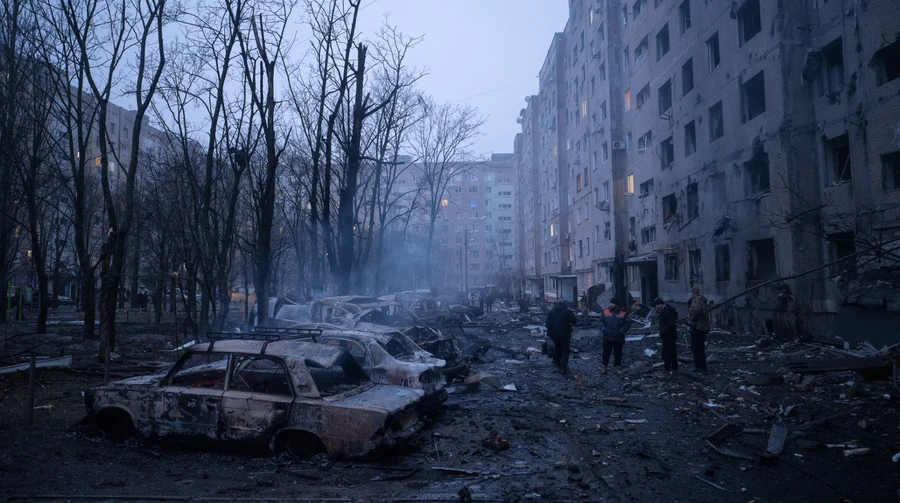
Russian forces dropped a FAB-250 aerial bomb equipped with a guidance kit on the city of Kramatorsk in Donetsk Oblast at around 05:00 on 8 February, killing one civilian and injuring three others, according to the Donetsk Oblast Prosecutor’s Office and Ukrainian outlet Podrobytsi.
The strike hit an area near an apartment building, resulting in the death of a 77-year-old woman. Three men aged 40, 46, and 48 sustained shrapnel wounds, blast injuries, concussions, and lacerations. A journalist from Podrobytsi, reporter Ihor Levenok, was also injured in the attack, suffering shrapnel wounds to his left arm while working at the scene.
The bombing caused significant damage to civilian infrastructure, including 11 apartment buildings and several cars. Law enforcement agencies have launched an investigation into the attack as a suspected war crime.
Russia strikes Ukrainian railways almost daily - Zelensky
President Volodymyr Zelensky has said that Russian forces are striking Ukraine’s railway infrastructure almost daily, but despite the constant attacks, the country is managing to maintain essential logistics.
In his evening address, Zelensky noted that Russian shelling of railway facilities has intensified, with targeted strikes reported nearly every day over the past week. On 8 February, a train in Chernihiv Oblast that was scheduled to carry passengers was hit. In previous days, railway infrastructure was also struck in Kharkiv and Dnipro oblasts.
Despite these attacks, Zelensky underlined that Ukraine’s railway system continues to operate, crediting railway workers and security personnel for ensuring uninterrupted service and protecting critical transport routes.
He also emphasized the urgent need for additional support from Ukraine’s international partners, particularly in the form of air defence systems and missiles. Zelenskyy stressed that protection against Russian ballistic missile strikes is required on a daily basis, noting that ballistic missiles once again hit Kyiv Oblast on 8 February. He added that no country should be left without assistance when facing such sustained and intense attacks.
Russia hit Kyiv with ballistic missiles
Around 9 p.m., explosions shook Kyiv as Russia launched another missile attack. Earlier in the evening, at approximately 5:30 p.m., explosions were also reported amid a ballistic missile threat. Kyiv Mayor Vitalii Klitschko confirmed that Ukraine’s air defence systems were actively intercepting incoming missiles, while authorities urged residents to remain in shelters.
Shortly after the attack, power outages were reported in at least one district of the capital, with electricity cut off earlier than scheduled. The strike came as part of Russia’s ongoing drone and missile campaign targeting Ukraine’s energy infrastructure, which has caused extensive damage to the national power grid and led to prolonged blackouts during freezing winter conditions.
Earlier the same day, Ukraine’s state grid operator Ukrenergo warned that the country’s energy system remained under severe strain. The company reported that several nuclear power plants had been partially disconnected from the grid following a large-scale Russian attack on critical infrastructure overnight on 7 February, further worsening the already difficult situation for Ukraine’s energy sector.