


Zelensky and Rubio discussed air defense for Ukraine and the possibility of leader-level peace talks
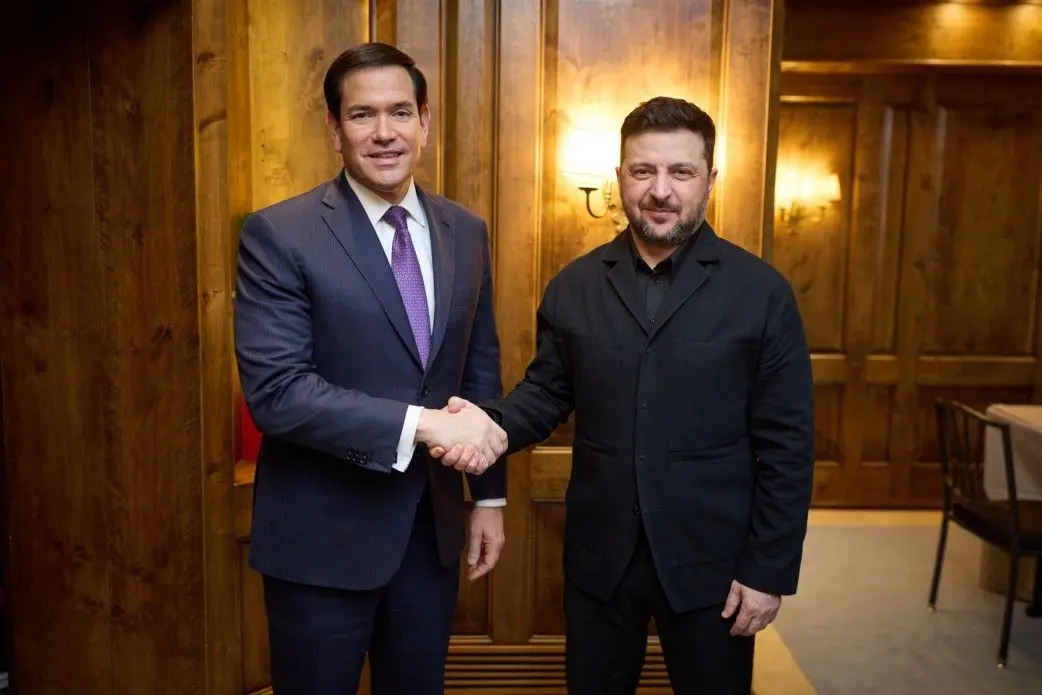
President Volodymyr Zelensky met with U.S. Secretary of State Marco Rubio on the sidelines of the Munich Security Conference on February 14, according to Presidential Office spokesperson Serhii Nykyforov. The talks focused on the battlefield situation, continued Russian strikes, and the damage inflicted on Ukraine’s energy infrastructure. The two sides also discussed strengthening Ukraine’s air defense capabilities during the winter months, particularly through the supply of additional missiles.
Zelensky and Rubio reviewed preparations for the next round of trilateral peace talks between the United States, Ukraine, and Russia, scheduled to take place in Geneva on February 17–18. After the meeting, Zelensky said Kyiv expects the negotiations to be substantive and expressed appreciation for what he described as a constructive U.S. approach. He noted that discussions included the sequence of steps in the peace process, with particular attention to security guarantees and economic recovery. The Presidential Office later stated that Ukraine considers a future leaders’ summit involving the heads of state of Ukraine, the U.S. and Russia necessary to address the most difficult issues.
Following his meeting with Rubio, Zelensky held a phone call with U.S. envoys Steve Witkoff and Jared Kushner to discuss the upcoming Geneva talks, previous negotiations in Abu Dhabi, and coordination with Washington. Zelensky said not all details could be disclosed publicly and that Ukraine’s negotiating team would present its position the following week. Speaking to journalists, he revealed that the United States had proposed a 15-year security guarantee for Ukraine, while Kyiv is seeking a longer-term commitment. Zelensky also responded to recent remarks by President Donald Trump, urging him to accelerate efforts toward a peace deal, suggesting that such statements may be aimed at shaping the atmosphere ahead of negotiations, while emphasizing that Ukraine would pursue progress without compromising its dignity.
Former Energy Minister detained at the border attempting to leave the country amid Ukraine`s biggest corruption case
Former Energy Minister Herman Halushchenko was detained on February 15 while attempting to cross Ukraine’s border, the National Anti-Corruption Bureau of Ukraine (NABU) reported. Detectives carried out the detention as part of the so-called Midas case, which is linked to the broader Energoatom corruption investigation — described as the largest anti-corruption case during President Volodymyr Zelensky’s tenure. Eight suspects have already been formally charged.
According to Ukrainska Pravda, Halushchenko was removed from a train. Radio Free Europe/Radio Liberty’s investigative project Schemes reported that he was detained under Article 208 of Ukraine’s Criminal Procedure Code, which allows law enforcement officers to detain a suspect without a court warrant. He is reportedly being transported to Kyiv for questioning and further investigative procedures. Border guards had allegedly been instructed by NABU and the Specialized Anti-Corruption Prosecutor’s Office (SAPO) to notify authorities if he attempted to leave the country.
Halushchenko served as energy minister from 2021 to 2025 before being appointed justice minister in July 2025. In November, NABU searched properties linked to him as part of the Energoatom probe. During court hearings that month, prosecutors cited audio recordings in which suspects allegedly discussed dividing kickbacks and mentioned a figure nicknamed “Professor,” whom investigators believe to be Halushchenko. Ukraine’s parliament approved his resignation on November 19 after President Zelensky publicly called on him to step down. The investigation remains ongoing.
Kyiv on brink of catastrophe due to Russian attacks – mayor
Kyiv has been on the brink of catastrophe over the past two months due to intensified Russian attacks on critical infrastructure, Mayor Vitalii Klitschko said in an interview with the Financial Times.
Klitschko warned that sustained airstrikes have pushed the capital to a critical point.
“Right now, the question of the future of our country – whether we will survive as an independent country or not – is still open,” he said.
The city’s roughly 3.5 million residents are facing what officials describe as the harshest winter since the start of Russia’s full-scale invasion. Temperatures have dropped below minus 20 degrees Celsius, with Kyiv blanketed in thick ice and snow.
Russia has compounded the humanitarian strain by launching waves of missiles and drones at energy infrastructure, leading to widespread outages of electricity, heating, and water. According to city authorities, strikes have targeted three major power plants that supply Kyiv’s centralized heating system, along with other energy facilities across Ukraine.
Despite the severe pressure, municipal services continue operating under emergency conditions as officials work to stabilize essential infrastructure.