


Polish president on Ukraine reaffirmed that Poland's help for Ukraine is in Warsaw's strategic interests
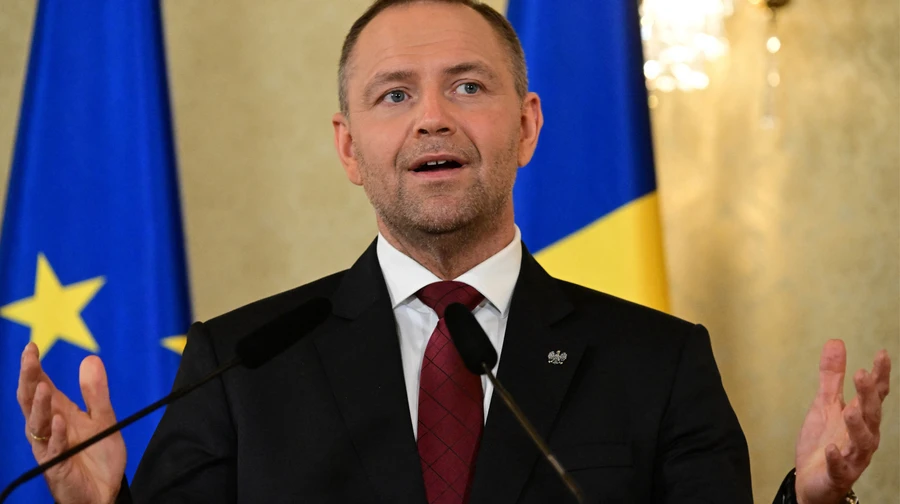
Polish President Karol Nawrocki said Poland will continue supporting Ukraine in its war against Russia because it serves Warsaw's strategic interests, while reaffirming his government's firm stance on historical disputes between the two countries.
Speaking on the anniversary of taking office, Nawrocki said Poland's security depends on Ukraine successfully resisting Russian aggression and keeping Russian forces as far from Poland's borders as possible. He stressed that Poland would continue assisting Ukraine because weakening Russia is in Poland's national interest.
At the same time, Nawrocki said Poland would maintain its position on historical issues, declaring that symbols associated with the World War II-era Ukrainian nationalist movement have no place in Poland. He added that Warsaw is prepared to support Ukraine while also expecting progress on issues important to Poland, emphasizing that cooperation should be based on partnership and the principle of "Poland first, Poles first."
Occupation authorities are staffing Combat Reserve units with the population of occupied areas to protect the Russian rear in Ukraine
Russian occupation authorities are continuing efforts to recruit residents of occupied Donetsk Oblast into local BARS (Combat Army Reserve) units tasked with air defense and security duties in the occupied territory.
According to available information, BARS-DNR is offering one-year contracts for service limited to occupied Donetsk Oblast rather than frontline combat. The unit is also being promoted as an alternative to compulsory military service. Applicants must hold Russian citizenship, be under 65 years of age, and have no criminal record.
The recruitment campaign appears aimed at shifting rear-area security responsibilities in occupied Ukraine from regular Russian forces to local residents. Occupation authorities are encouraging enlistment by offering salaries and benefits that far exceed average local incomes. In occupied Mariupol, for example, average monthly wages are estimated at 18,000–20,000 rubles ($240–267), while BARS-DNR reportedly offers a one-time payment of 38,900 rubles ($477) and a monthly salary of 209,000 rubles (about $2,600).
Under international humanitarian law, an occupying power is prohibited from compelling residents of occupied territory to serve in its armed or auxiliary forces. Analysts argue that, even if enlistment is formally voluntary, the economic hardship and coercive conditions created by the occupation raise serious concerns about the legality of such recruitment practices.
The US intelligence warns that Russia could test NATO as early as this fall
U.S. intelligence has warned that Russian President Vladimir Putin could attempt a limited attack against a NATO member as early as this fall, according to The Wall Street Journal report. The article claims that U.S. officials previously believed Russia was too focused on its war against Ukraine to confront the alliance directly, but now assess that Moscow could launch a large-scale hybrid operation or a limited ground incursion between this fall and 2029. The attack would likely target NATO's eastern flank to test the alliance's Article 5 collective defense commitment.
The assessment aligns with recent warnings from European officials. Lithuania's defense minister said intelligence indicates Russia may stage provocations in the Baltic region, including possible false-flag attacks using Ukrainian-made drones against critical infrastructure. The warning follows a series of drone incidents across the Baltics and Germany, where an unidentified FPV drone reportedly struck a Ukrainian cargo plane at Leipzig airport. German Interior Minister Alexander Dobrindt described the incident as a "hybrid attack scenario."
According to the WSJ, U.S. officials believe Russia's limited battlefield gains in Ukraine and Kyiv's increasingly effective strikes deep inside Russian territory could push the Kremlin to seek a symbolic victory against NATO. The report also noted that the United States faces shortages of key air defense munitions, including Patriot and THAAD interceptors, after the war with Iran. President Donald Trump acknowledged the shortages, saying the U.S. "needs missiles too," while President Volodymyr Zelensky has warned that Western deliveries of air defense missiles fell by two-thirds in the first half of 2026 compared with the same period last year.
Taking advantage of those shortages, Russia has intensified ballistic missile attacks on Ukraine, including a recent strike near Kyiv in which none of the incoming ballistic or hypersonic missiles were intercepted.