


Russian ballistic missile attack killed 17, injured 44 in Kyiv, targeted business infrastructure
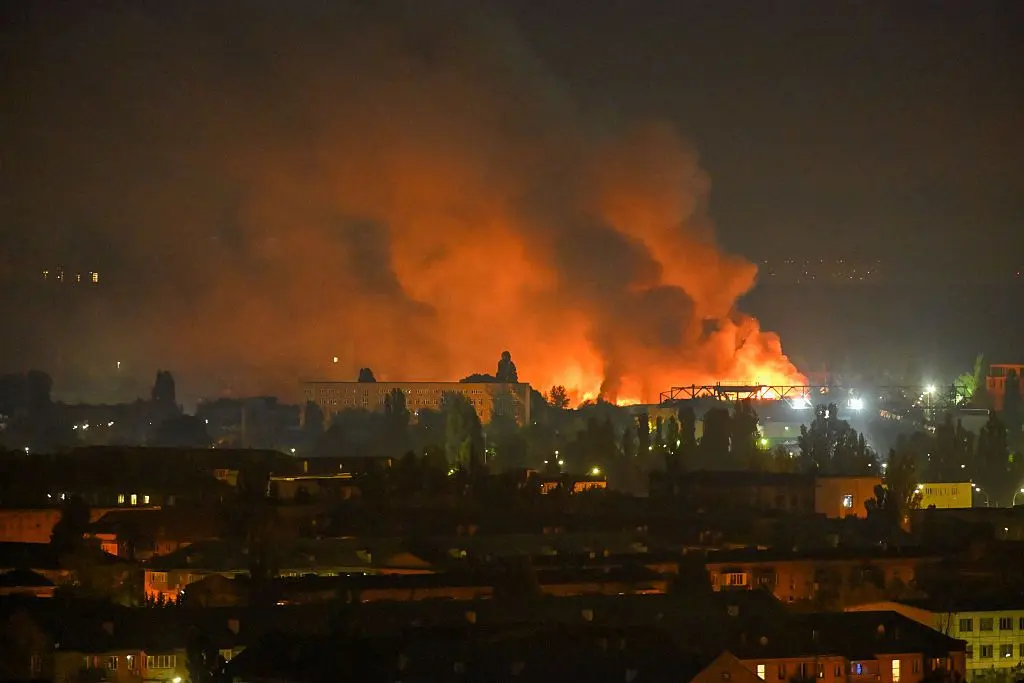
Russia has carried out another heavy strike on the capital. The attack included launching 24 Iskander-M or S-400 ballistic missiles, four Zircon or Onyx anti-ship missiles, and roughly 115 Shahed-type and other attack drones against Kyiv and the surrounding region. President Volodymyr Zelensky reported that at least 17 people were killed and 44 injured in the assault, extending condolences to the families of the victims. The barrage was concentrated on the capital, with more than 30 missiles reportedly directed at Kyiv, and emergency crews responded to impacts across multiple districts, including a significant hit in the Obolonskyi district.
Russian occupation forces launched a missile strike on Kyiv using ballistic missiles, causing large-scale fires to break out in the city.
This attack deliberately targeted civilian commercial and logistics infrastructure. Zelensky explicitly described the struck sites as facilities unrelated to the war, listing a brewing company, building-material warehouses, and civilian logistics operations. Among the businesses hit were warehouses and hubs belonging to some of Ukraine's largest household names in retail and delivery: Epicentr (a major hardware and electronics chain), Rozetka, Fozzy Group, and Nova Poshta. The strikes followed the systematic Russian campaign against the retail and delivery networks that ordinary Ukrainians depend on for daily life.
The strike on Rozetka, Ukraine's biggest online retailer, was especially notable because it marked a repeated attack on the same critical asset. Russia struck the company's largest warehouse again — reportedly for the second time in a 24-hour span, with two Shahed drones hitting the facility overnight. This came on top of earlier August strikes on Rozetka's main logistics hub in Brovary in the Kyiv region, where an earlier attack on August 1 killed one employee and injured seven others while some 270 people were working on-site. Rozetka co-founder Iryna Chechotkina described watching three ballistic missiles strike and set fire to what she called her life's work, and the company characterized the repeated targeting as "clearly not a coincidence." Despite losing one of its most important logistics sites, Rozetka stated it would continue operating. This facility is central to the company's ability to fulfill the enormous daily order volume it handles for a customer base that is the largest of any online store in the country.

The attack on Nova Poshta, Ukraine's dominant private postal and parcel-delivery service, caused casualties directly. A Nova Poshta sorting center in Kyiv's Obolonskyi district was destroyed, with the company reporting that Russia used cluster munitions in the strike. Two drivers working for a partner transportation company and one contractor were killed, and eight others were injured. This strike is part of a much broader and sustained assault on Nova Poshta's network: over recent months, Russian forces have hit more than 20 of the company's large warehouses and terminals across cities including Kyiv, Kharkiv, Poltava, Dnipro, Zaporizhzhia, Sumy, and others. Earlier in the campaign, a strike destroyed the company's only fully automated sorting terminal — equipment supplied by the Dutch firm Vanderlande — for which Nova Poshta had no backup capacity, removing a unique bottleneck from its national logistics chain.


Taken together, the strikes reflect a form of economic warfare aimed at degrading Ukraine's civilian logistics and commerce. Each destroyed facility reduces the country's shipping throughput, raises costs, and forces businesses to reroute or delay operations, while inflicting casualties on civilian workers who staff these sites during working hours. Russian officials have at times attempted to justify strikes on such companies with disinformation claims, but the practical effect is the disruption of everyday supply chains that millions of Ukrainians rely on.
Russia dropped on Ukraine over 8,300 glide bombs in July, a record figure since the full-scale invasion
Russian forces launched more than 8,300 guided glide bombs against Ukraine in July, the highest monthly total on record, Ukraine's Defense Ministry said on Aug. 4, citing General Staff data.
The ministry said the figure surpassed the previous monthly record of 8,266 set in June. Russian forces increasingly use these weapons not only against military positions near the front but also against residential areas in cities farther from the front line, contributing to a growing number of civilian casualties.
Known in Ukraine as KABs, the weapons are conventional aerial bombs fitted with wings and precision guidance systems, allowing them to glide for tens of kilometers after being released by aircraft such as the Su-34 from beyond the range of many Ukrainian air defense systems. Depending on the model, they carry warheads weighing from about 300 kilograms to 3 metric tons, making them capable of destroying multi-story buildings with a direct hit.
Russia typically employs glide bombs against fortified military targets, including bridges, command posts, and drone teams. In practice, however, they have also been used extensively against populated areas, causing widespread destruction in front-line cities such as Dobropillia, Sloviansk, and Kramatorsk, as well as larger regional centers including Kharkiv and Zaporizhzhia. While the bombs are equipped with guidance systems, they remain relatively inaccurate and can sometimes be diverted by electronic warfare systems.
Putin allows broader recruitment of convicts for war in Ukraine
Russian President Vladimir Putin has signed amendments expanding the categories of people with criminal records who are eligible to sign contracts with Russia's Defense Ministry, according to Radio Liberty.
Under the revised law, people convicted of or under investigation for minor and medium-gravity offenses may now enlist. The changes also apply to some crimes involving the illegal trafficking of weapons and explosives, violations of safety regulations, and certain military- and transport-related offenses.
The restrictions remain in place for individuals convicted of or under investigation for more serious crimes, including offenses against the sexual integrity of minors, terrorism, treason, espionage, sabotage, extremism, extortion, and other crimes against the state and public security.
According to Ukraine's General Staff, as of Aug. 3, Russia's total military casualties since the start of the full-scale invasion had reached approximately 1,451,750 killed and wounded.