


,
The coalition of Eurosceptic Rumen Radev won the elections in Bulgaria
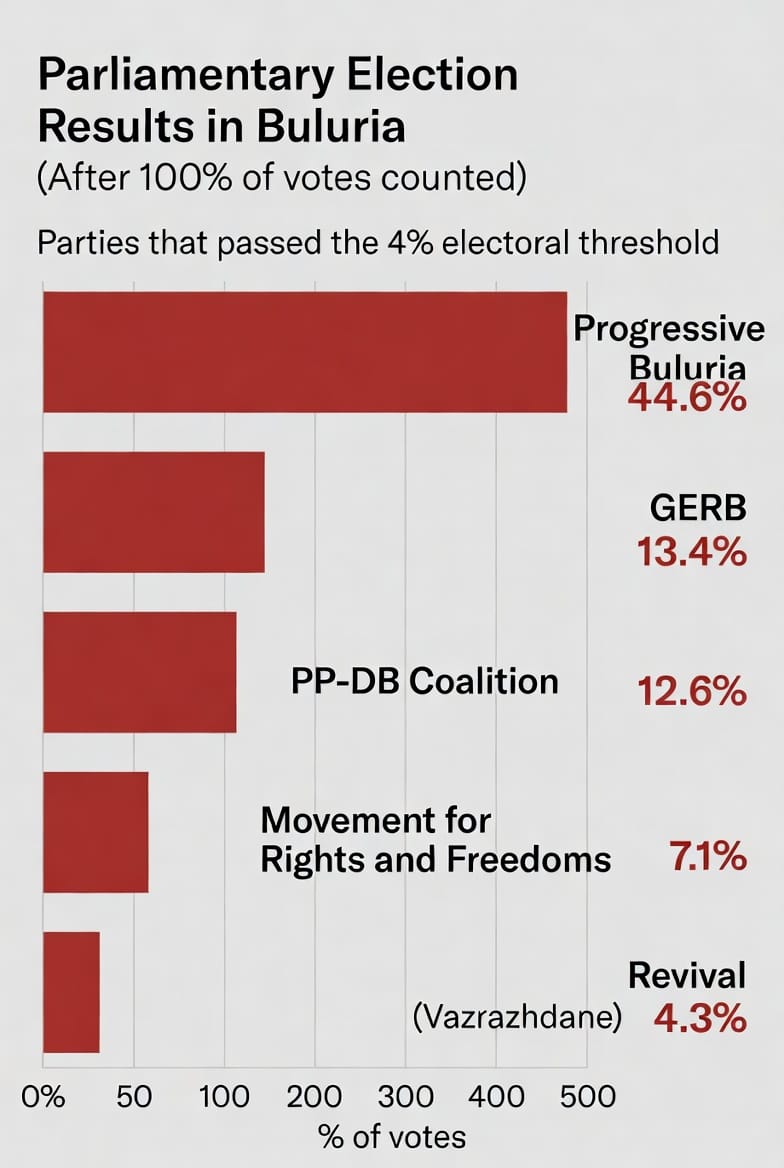
The Progressive Bulgaria coalition led by former president Rumen Radev has won Bulgaria’s early parliamentary elections, securing a strong lead with about 44.7% of the vote and an estimated 130 out of 240 seats in parliament. The result gives the coalition a potential outright majority, allowing it to form a government independently.
In second place came the GERB-SDS alliance of former prime minister Boyko Borisov with 13.4%, followed by the reformist bloc Continue the Change–Democratic Bulgaria at 12.6%. While Radev’s coalition appears capable of governing alone, he has not ruled out cooperation with other pro-reform forces.
Two additional parties also entered parliament: the Movement for Rights and Freedoms with 6.76%, representing mainly the Turkish minority, and the nationalist Revival Party with 4.3%, led by Kostadin Kostadinov, who has previously advocated maintaining ties with Russia.
Two civilians killed and 13 injured in Russian attacks on Nikopol, Kharkiv, and Kharkiv Oblast
On April 20, Russian forces carried out multiple drone attacks on Nikopol in Dnipropetrovsk Oblast and several locations in Kharkiv Oblast, killing at least two civilians and injuring several others.
In Nikopol, two elderly women were killed when a Russian FPV drone struck the city. A 77-year-old woman died instantly, while an 83-year-old woman was rushed to the hospital in critical condition but could not be saved. Seven other people were injured in the attack, which also damaged five-story residential buildings, a private house, and several cars.
In the Kharkiv region, a Russian drone hit a petrol station in the town of Bohodukhiv, injuring three men aged 43, 45, and 64. A fire broke out at the scene, and multiple vehicles were damaged. Later the same day, another Russian drone strike targeted the Osnovianskyi district of Kharkiv city, injuring three people. Ukrainian authorities have opened criminal proceedings against Russia for war crimes in connection with the attacks.
IMF might exclude a demand for unpopular tax changes for Ukraine
The International Monetary Fund (IMF) has acknowledged that one of the conditions tied to its $8.1 billion program for Ukraine may be “non-constructive,” according to Prime Minister Yulia Svyrydenko, following talks in Washington, D.C.
Ukraine had agreed to introduce four new taxes under the program signed in October 2025 to boost state revenues. However, one of the most controversial measures — a value-added tax on self-employed entrepreneurs — has faced strong domestic opposition.
Svyrydenko said that during the IMF and World Bank Spring Meetings, Ukrainian officials received signals from partners that the measure is politically and economically sensitive. Kyiv now plans to work with the IMF on alternative ways to secure budget revenues for 2027.
According to sources, discussions on revising parts of the program could take place as early as May, when an IMF delegation is expected to visit Ukraine. This would mark the second time the fund has eased conditions under the current arrangement.
The loan program, which runs over four years, is designed not only to provide direct financial support but also to unlock additional funding from international partners. IMF-backed reforms are seen as key to stabilizing Ukraine’s economy during the ongoing war and aligning it more closely with global financial standards.
Hungary's incoming PM urges Zelenskyy to resume oil transit via Druzhba pipeline
Pуter Magyar, Hungary’s incoming prime minister and leader of the Tisza Party, said he expects Volodymyr Zelensky to restore the flow of Russian oil through the Druzhba pipeline if it is technically operational.
Speaking to the press, Magyar urged the Ukrainian president to “keep his promise” and suggested that supplies could resume in the coming days. He stressed that Hungary would not agree to any concessions on the issue.
Magyar also warned against what he described as potential “blackmail,” saying such an approach would not be accepted either in Hungary or across European Union countries. He argued that previously agreed arrangements should not be revised under pressure.
Using a metaphor, Magyar compared the situation to a guest making demands at a dinner they were invited to, calling that approach misguided.