
The Vote That Could Hand Putin a Second EU Veto
April 19 will determine not only who governs Sofia, but whether another piece of Europe's eastern front holds.

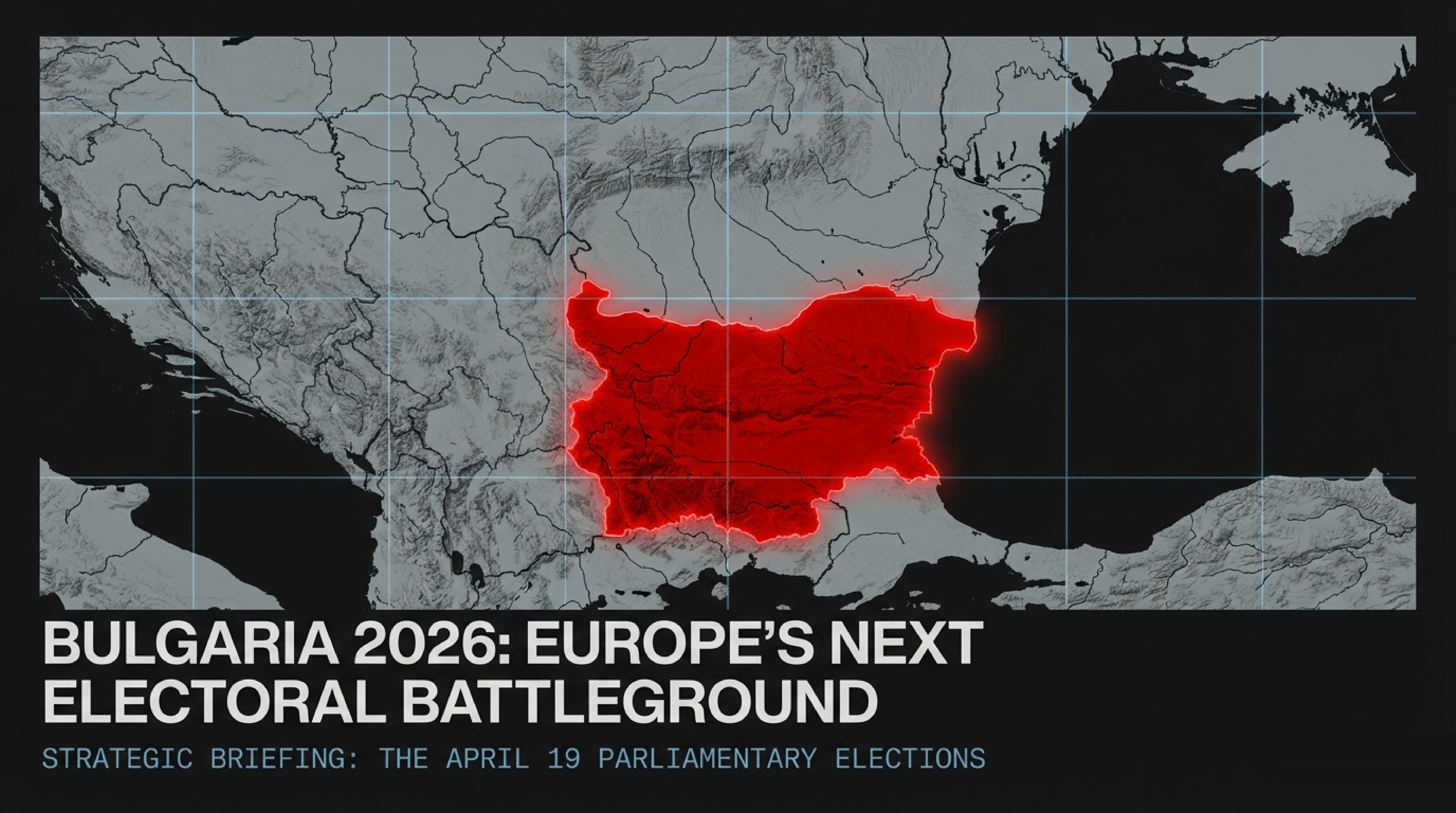
On April 19, Bulgaria goes to the polls for the seventh time in five years. If current polling holds, the country will elect a pro-Russian government capable of halting weapons shipments to Ukraine, handing Moscow a second permanent veto inside the EU, and fracturing NATO's Black Sea flank. The question is no longer does Russia interfere in Bulgarian democracy. The question is whether it is about to succeed.
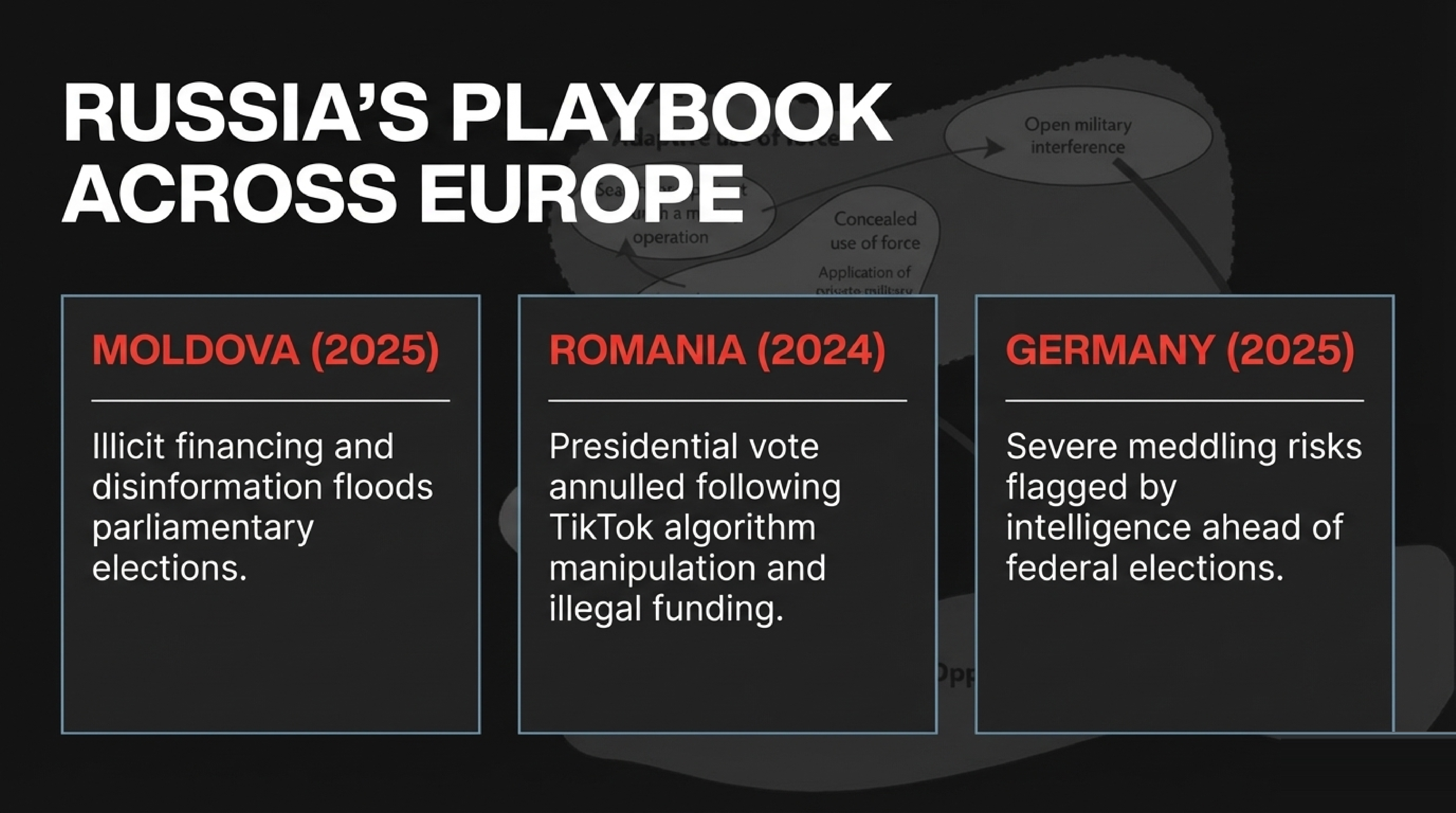
There is a reason this matters beyond Sofia. The country operates Soviet-era artillery manufacturing capacity that remains vital to Ukraine's defense. It secures the alliance's vulnerable Black Sea flank against ongoing Russian naval posturing. And it wields a decisive veto in the European Council. What happens in Sofia on April 19 will reverberate from Brussels to Kyiv and beyond.
Seven Elections, Zero Stability
When the GERB-SDS government fell in December 2025 under the weight of street protests and coalition infighting, it left behind something worse than a political crisis. It left a vacuum. The kind that gets filled by people who have been waiting for exactly this moment.
Five years of revolving governments have ground Eurozone integration to a halt, left judicial reform untouched, and made political predictability a thing Bulgarians no longer expect. The exhaustion is real. People stop paying close attention after the fourth or fifth election. They stop showing up. And when a population disengages from its own democracy, Moscow does not need to break anything. The door is already open.
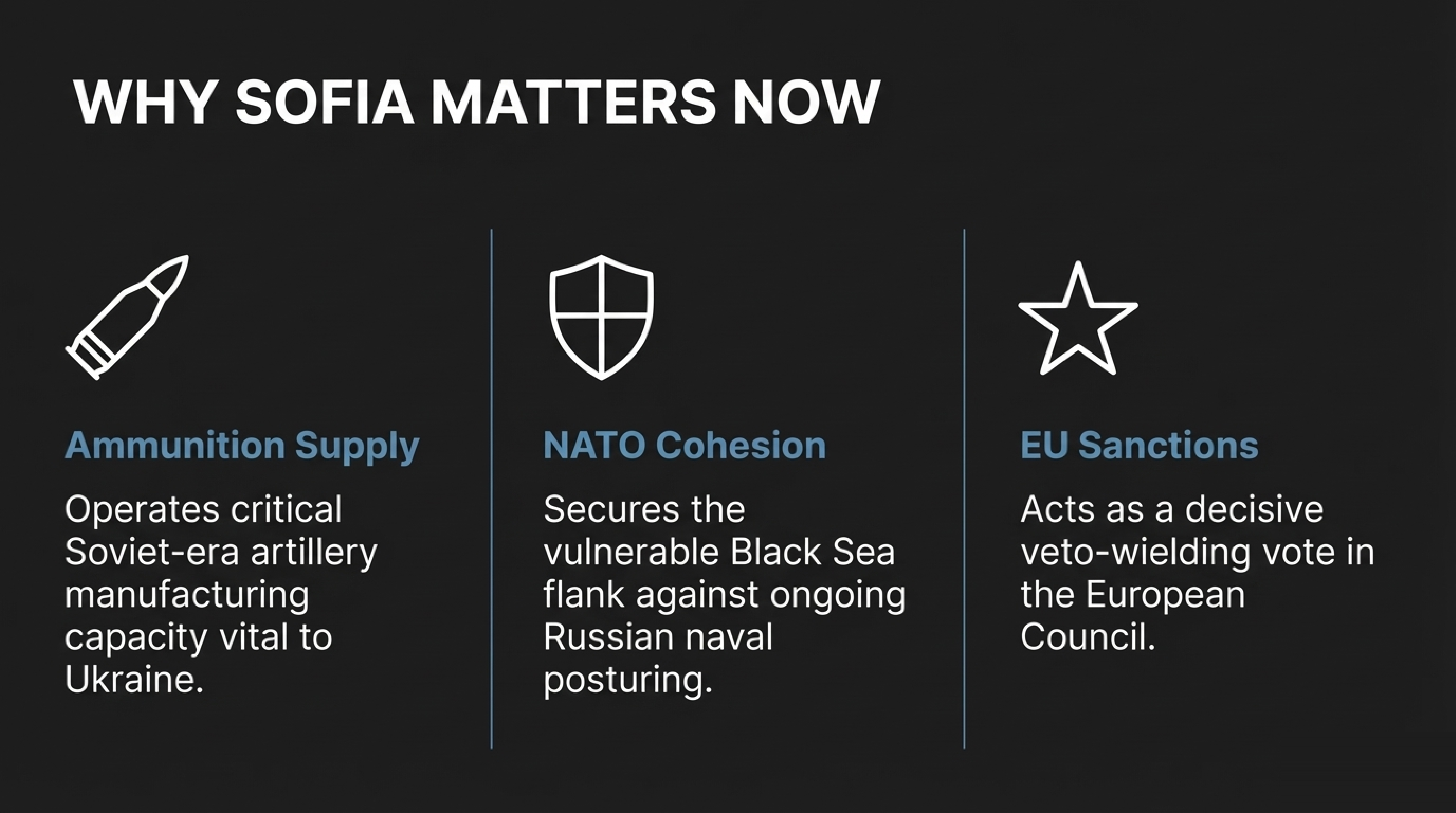
Bulgaria does not face this alone. Illicit Russian financing flooded Moldova's 2025 parliamentary elections. Romania's 2024 presidential vote was annulled after intelligence agencies confirmed TikTok algorithm manipulation and illegal Kremlin-linked funding. Severe meddling risks were flagged by German intelligence ahead of the 2025 federal elections. The pattern is well documented, the playbook consistent, and Bulgaria appears to be the next target in line.
The Radev Surge
What changed everything this cycle is Radev's return to the legislative arena. His newly formed party, "Progressive Bulgaria," leads current polling at 21.1%.
It appropriates the "progressive" label while steering a staunchly nationalist, Eurosceptic course. Radev's platform calls for what he terms "strategic neutrality," which in practical terms means distancing Sofia from NATO's collective defense posture and restoring diplomatic engagement with Moscow.
His supporters flatly reject the "pro-Russian" label. They frame the platform as sovereignty-first, arguing that Bulgaria's Western alignment has delivered neither prosperity nor stability. The seven elections, they say, are proof enough. Whether this constitutes principled nonalignment or serves as vehicle for a Moscow-aligned pivot depends entirely on who you ask.
Ivan Zheved, who heads the civil society organization "GID," does not equivocate:
"A pro-Russian coalition government in Sofia could halt the supply of ammunition and weapons to Ukraine and create a new government in Eastern Europe similar to Orban's."
Dimitar Ganev, political analyst at the Trend Research Center in Sofia, offers a more careful reading: "Radev's voters are not all pro-Russian. Many are simply exhausted. The danger is that their exhaustion is being channeled toward a geopolitical outcome they may not fully grasp."
A Three-Way Stalemate
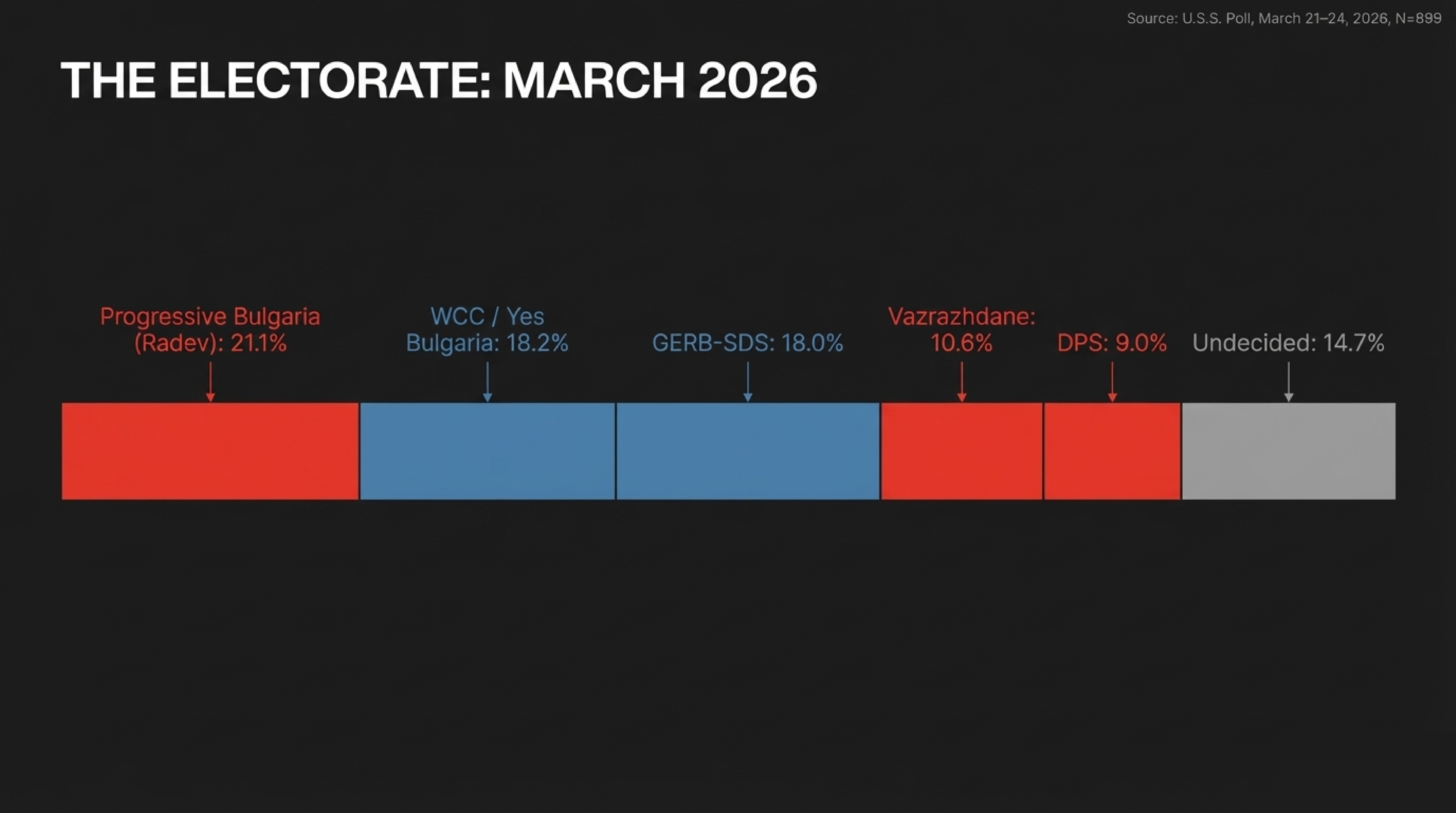
Polling data from research firm U.S.S., commissioned by the civil society organization "GID" (survey conducted March 21-24, 2026, n=899, margin of error ±3.3%), shows an electorate locked in a three-way ideological deadlock.
| Party / Bloc | Support |
|---|---|
| Progressive Bulgaria (Radev) | 21.1% |
| We Continue the Change / Yes, Bulgaria | 18.2% |
| GERB-SDS | 18.0% |
| Revival (Vazrazhdane) | 10.6% |
| DPS (Peevski) | 9.0% |
| United Left (BSP) | 4.6% |
| Undecided | 14.7% |
The gap between first and third place sits at 3.1 percentage points, well within the margin of error. The election could tip in any direction.
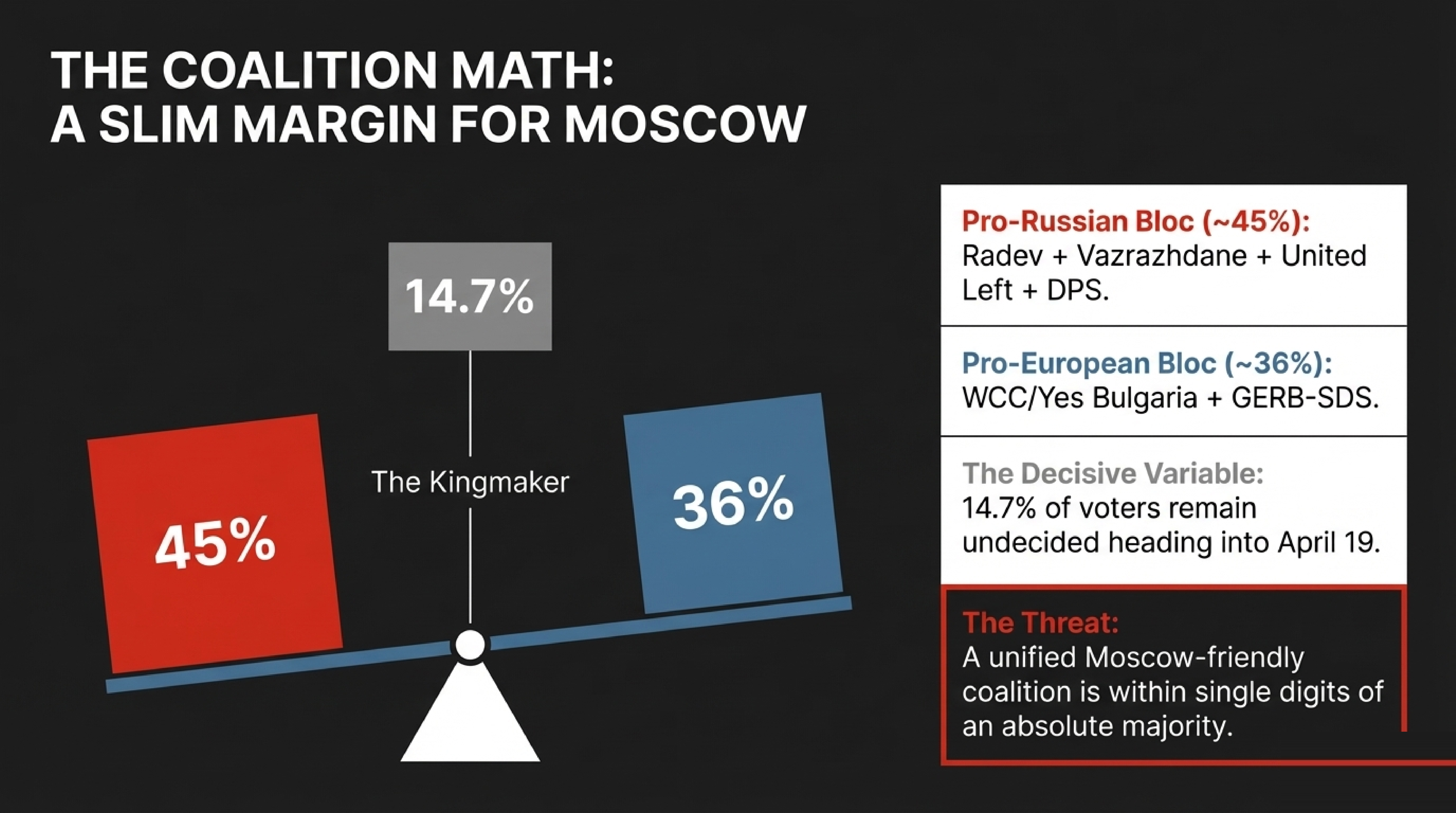
The coalition arithmetic, however, favors Moscow. Progressive Bulgaria (21.1%), Revival (10.6%), and the United Left (4.6%) together command approximately 36% of the total electorate, or close to 45% of decided voters. The pro-European center, split between two rival formations polling at 18.2% and 18.0%, cannot form a majority on its own. The kingmaker sitting between these blocs is perhaps the most paradoxical figure in all of Bulgarian politics.
The Magnitsky Kingmaker
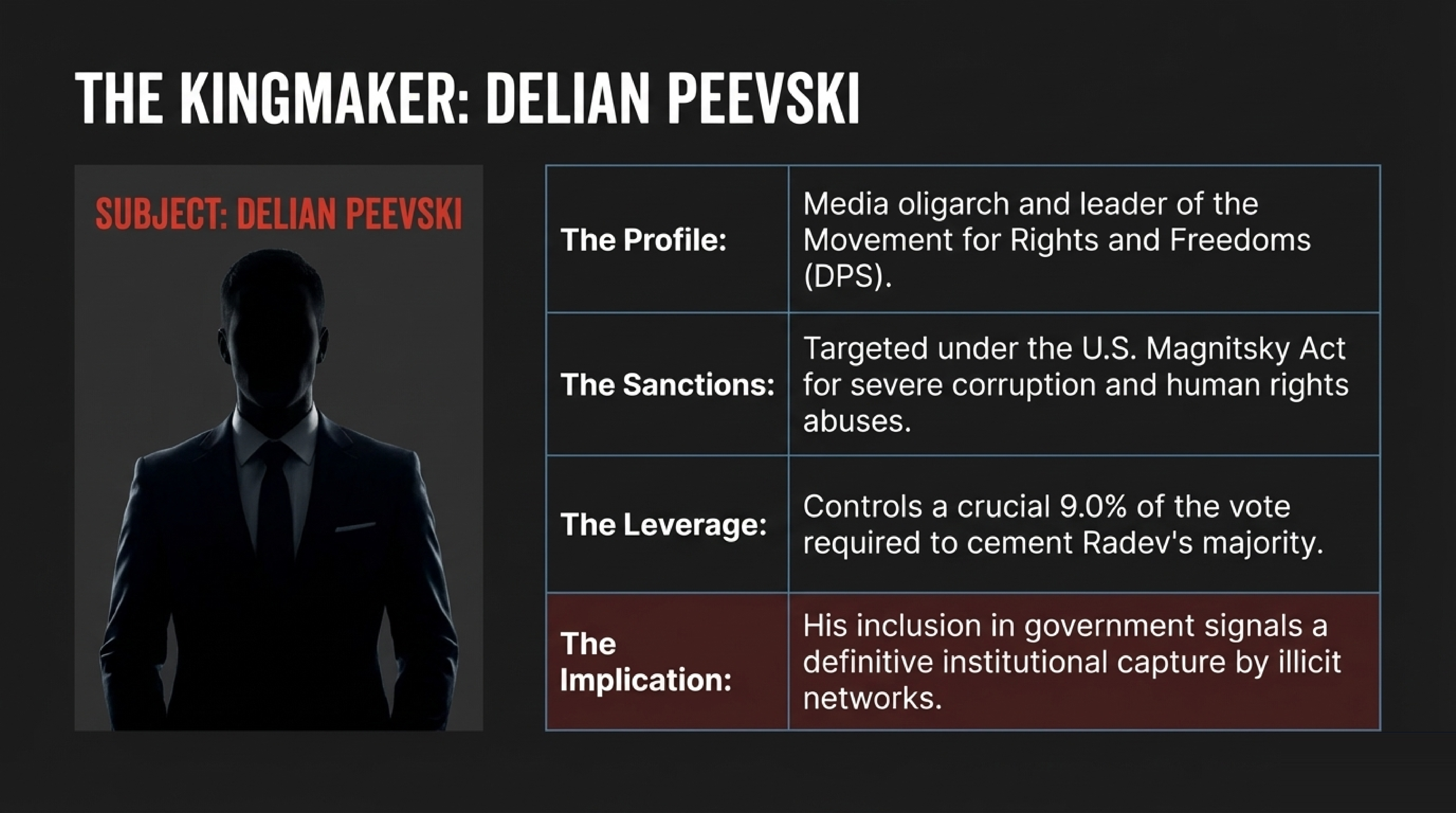
The "Movement for Rights and Freedoms" (DPS) commands 9.0% of the vote. Its leader, Delian Peevski, is a media oligarch designated under the U.S. Global Magnitsky Act for significant corruption and involvement in serious human rights abuse. The Treasury Department sanctioned Peevski in June 2021, freezing his American-held assets and barring U.S. entities from conducting business with him.
A coalition that markets itself as defending Bulgarian sovereignty from Western interference may well depend for its parliamentary majority on a man whom the United States has sanctioned precisely for undermining Bulgarian institutions. The DPS under Peevski represents not an ideology but a transactional apparatus, and in Bulgarian coalition politics, such an apparatus has always sold its votes to the highest bidder.
One Western diplomat stationed in Sofia, who spoke on condition of anonymity, put it plainly: "If Peevski is the price of a majority, that tells you everything you need to know about the nature of that majority."
The Orban Parallel
For NATO and the European Union, the implications reach well beyond Sofia's borders.
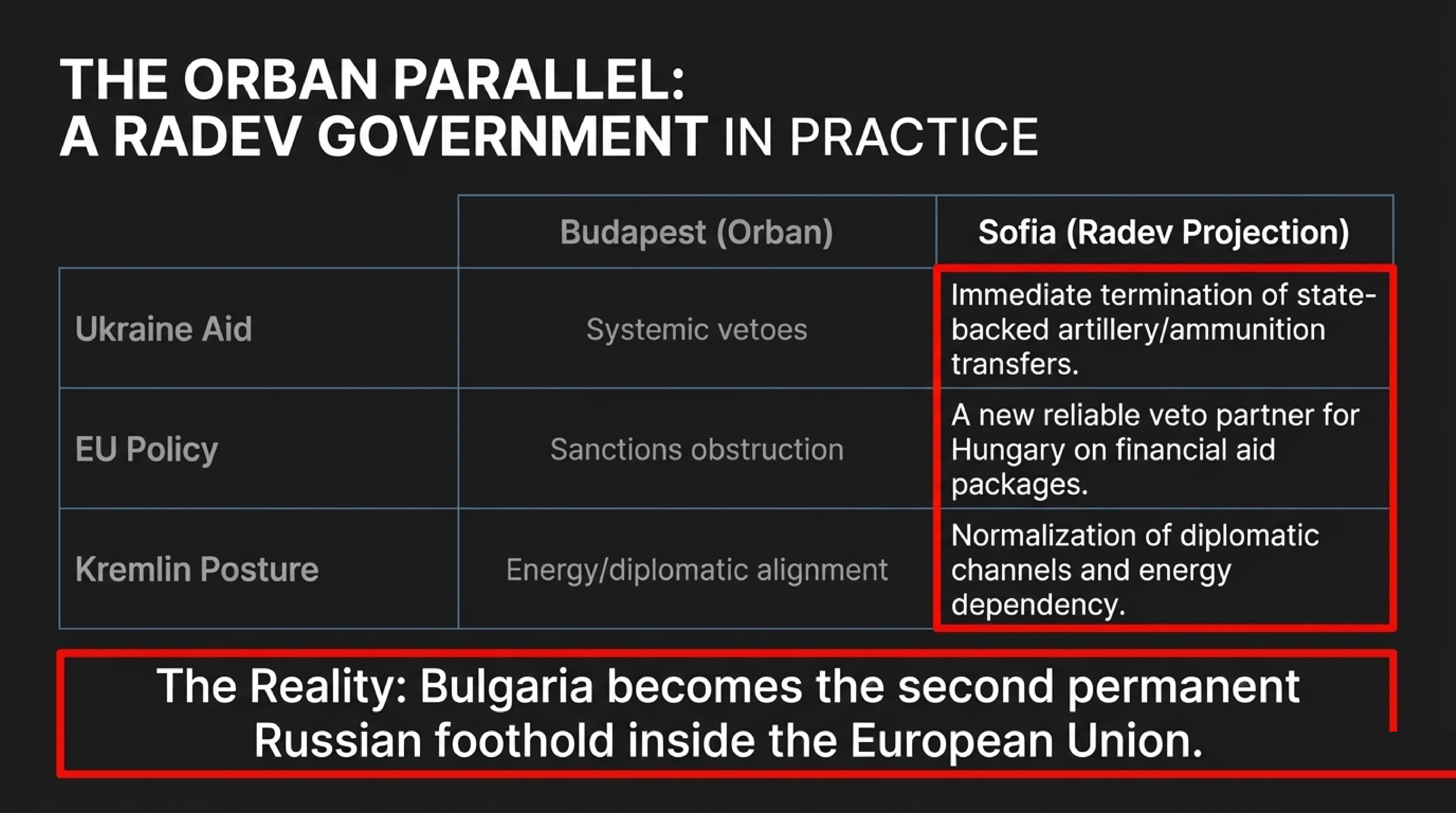
Anyone who watched what Orban did to Hungary over the past decade already knows what comes next.
On Ukraine aid: Orban has already deployed systemic vetoes on EU military assistance packages. A Radev government would go further, terminating state-backed artillery and ammunition transfers from Bulgarian factories. These facilities currently supply an estimated 30-40% of the 155mm shells reaching Ukraine's front lines.
On EU sanctions: Hungary already obstructs renewal of Russia sanctions at every opportunity. Bulgaria would become a second reliable veto partner, potentially breaking the unanimity that sanctions extensions require.
On energy: Orban has deepened Hungary's reliance on Russian gas via the TurkStream pipeline. A Radev government would reverse Bulgaria's hard-won energy diversification and hand Moscow renewed leverage over Sofia's energy security.
On NATO cohesion: Budapest has blocked NATO-Ukraine cooperation frameworks repeatedly. Sofia would add a second dissenting voice inside the alliance's consensus-based decision structure, compounding already significant institutional damage.
Bulgaria becomes the second permanent Russian foothold inside the European Union. And two vetoes are far more dangerous than one.
The Silent 14.7%
In the end, this election will be decided by the 14.7% who have not yet made up their minds.
In a race where the margin between first and third place is only 3.1%, the 14.7% who have not yet committed hold the power to flip the outcome completely. Historical precedent in Bulgarian elections suggests that undecided voters tend to break disproportionately toward established parties rather than new formations, which would favor GERB-SDS and the reformist bloc. But after seven consecutive elections, it is not at all clear that historical precedent still holds.
These voters represent either the last defense of Bulgaria's Western integration, or the final margin that cements the Orban model in the heart of the Balkans.
What to Watch: The Road to April 19
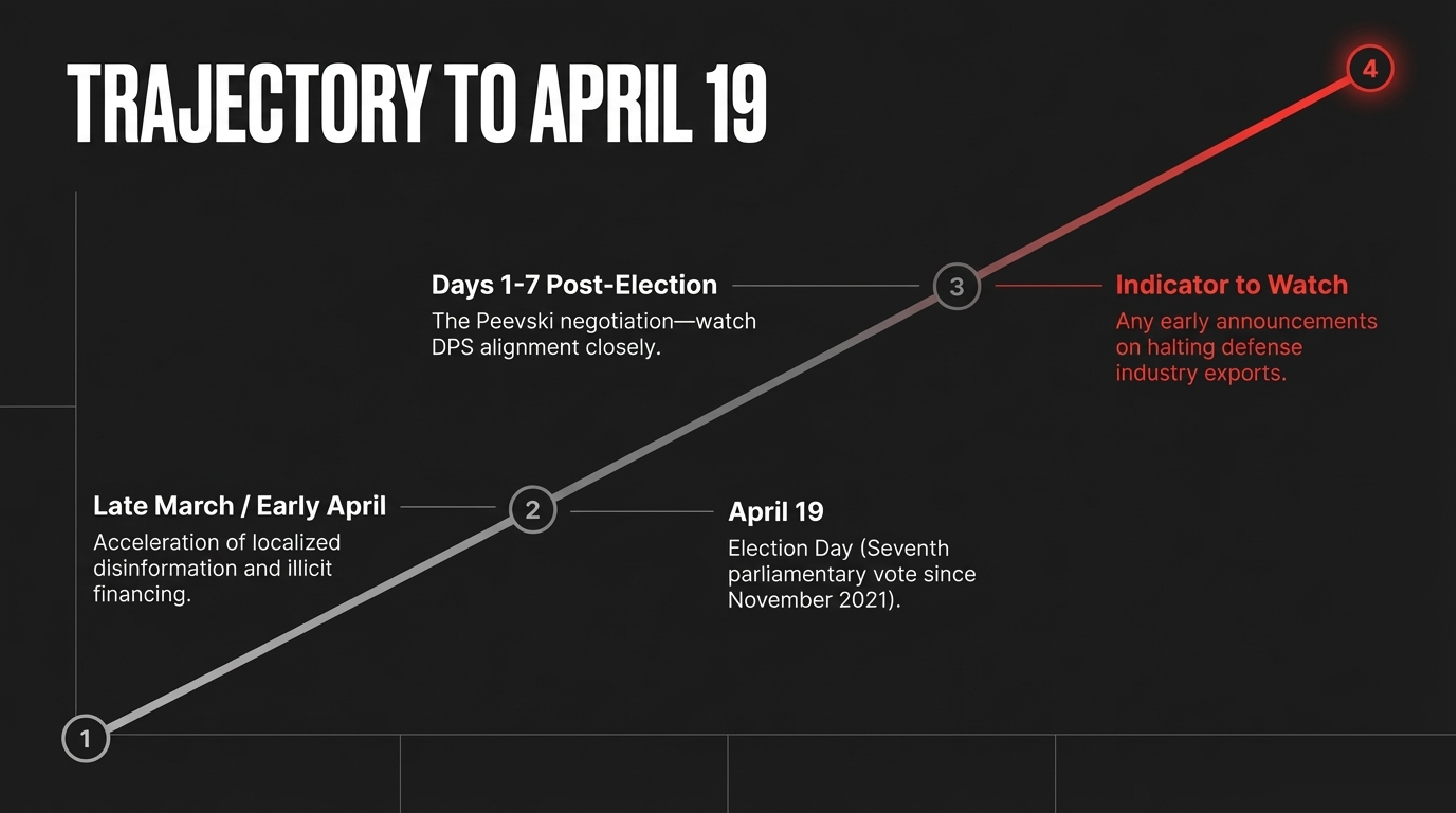
March 30 to April 5: The official campaign period opens. Watch closely for coalition signals from Radev toward Revival and BSP. Any formal alliance announcement confirms that the pro-Russian bloc is real and coordinated.
April 6 to 12: The final polling window before the pre-election blackout. The undecided figure at this stage will determine whether the result is foreseeable or chaotic.
April 13 to 18: Campaign blackout. No polls published. The ground game becomes everything: door-to-door canvassing, social media operations, diaspora mobilization.
April 19, Election Day: Turnout will be the critical variable. Voter fatigue from seven elections tends to suppress pro-European urban voters disproportionately; these constituencies historically show lower participation in repeat elections.
April 20 to May 15: Coalition formation. If no party crosses 120 seats out of 240, weeks of negotiation follow. Peevski's DPS will extract maximum concessions from whichever bloc requires his support.
Late May to early June 2026: The earliest window for government action on defense exports. Any halt in ammunition transfers to Ukraine could take effect before summer, at precisely the period when battlefield dynamics in eastern Ukraine historically intensify.
Sofia's Crossroad
Nobody in Sofia is treating April 19 as just another election, and neither should Brussels. It is a stress test for European security architecture at a moment when Russia probes every available seam. Bulgaria will either reaffirm its commitments to the West or become the second EU member state to function, in effect, as Moscow's representative from within.
For NATO planners, contingency work should already be underway. For Bulgaria's undecided voters, the weight of this decision is difficult to overstate. And for the Kremlin, April 19 represents something that does not come often in geopolitics: a chance to secure a strategic victory without firing a single shot.
Source: U.S.S. Research — "The Electoral Situation in Bulgaria at the End of March 2026"
Written by the editorial board of Nashe Pravo.